Wild Relatives: The white-naped crane
Editor’s note: Our Wild Relatives story series will explore the connections between our local wildlife species and related animals from around the globe. By learning about these exotic species, we hope to foster appreciation for the remarkable creatures that live in our backyards and neighborhoods.
With their long legs and necks, there's an elegance about cranes that is hard to ignore. Close to home, we can admire this elegance in sandhill cranes and whooping cranes when we are lucky enough to see them. All told, though, the world is home to 15 crane species, each elegant in its unique way.
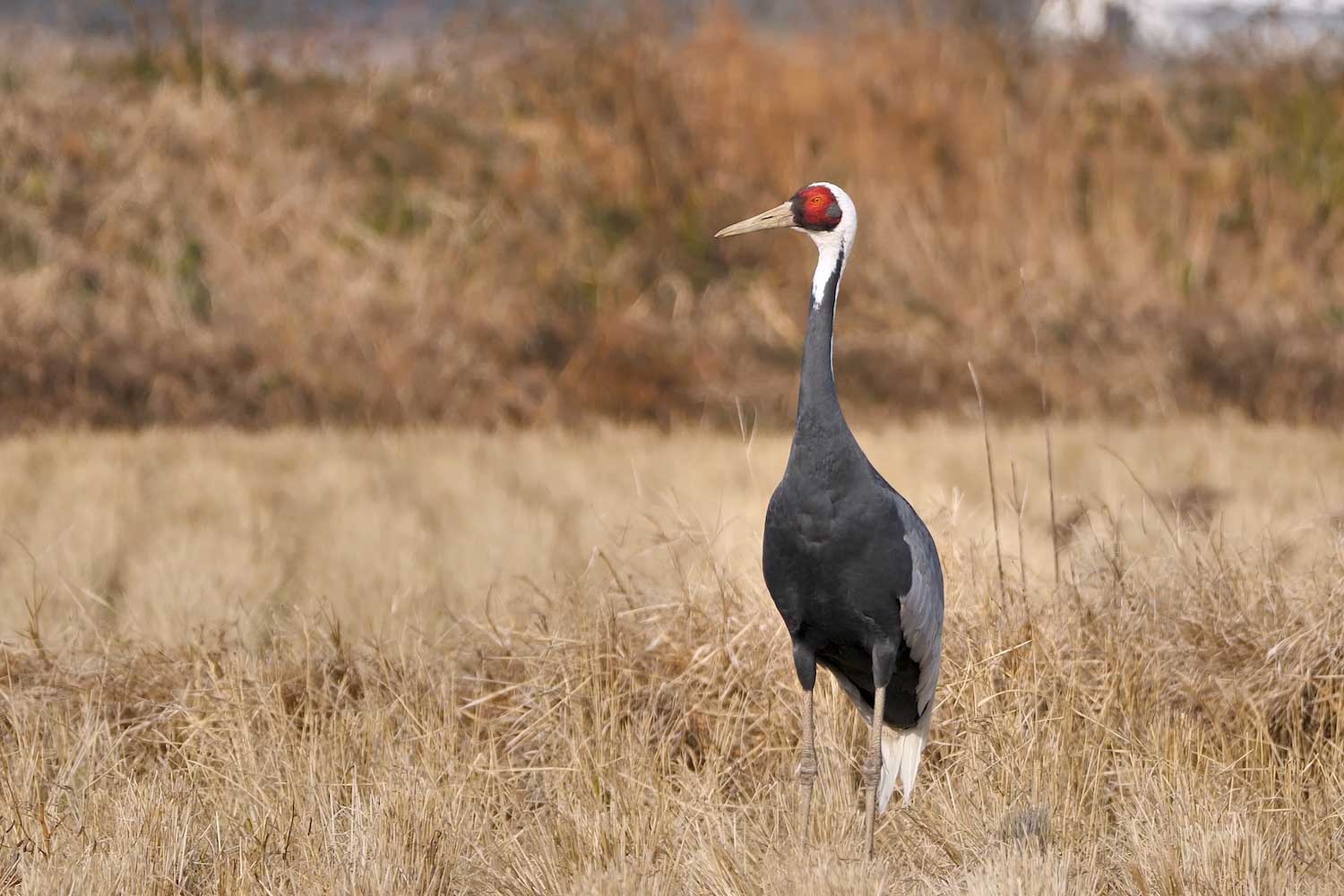
Among the world's crane species is the white-naped crane, a bird that looks a bit like a cross between a sandhill crane and a whooping crane. They have gray bodies like sandhill cranes, but the white-naped crane's body is a darker shade. Like whooping cranes, they have white necks with a deep red face marking. If you look closely at the white-naped crane, though, you'll see their necks are white in the back and gray in the front, creating a striped appearance, the National Zoo reports. The bright white color of the back of their necks is how they earned their common name.
Size wise, white-naped cranes are slightly bigger than sandhill cranes but smaller than whooping cranes. White-naped cranes are about 4 feet tall and weigh about 12 pounds, while sandhill cranes are between 3 feet and 4 feet tall and weigh between 8 pounds and 10.5 pounds. Whooping cranes can reach 5 feet tall, and they weigh 15 pounds.
Wetland wonders
Like sandhill cranes and whooping cranes, white-naped cranes are wetland birds, preferring to inhabit lakes, marshes, swamps and wet meadows along river valleys, according to the St. Louis Zoo. The wetlands where you will find these birds are far from Illinois, however.
White-naped cranes are native to parts of northeastern China, northeastern Mongolia and southeastern Russia. Part of the bird's population is migratory, and these birds winter in parts of Japan and the Demilitarized Zone (DMZ) between North Korea and South Korea.
Like our local cranes, white-naped cranes are omnivores, eating a mix of animal and plant matter. They eat insects and small vertebrates such as rodents and amphibians as well as roots, seeds and tubers. With their long bills, they are easily able to dig into soil to get at food sources below the surface. In the winter, they typically eat more seeds and grains. In some places where they winter, rice becomes an important component of their diet.
Song and dance
Many crane species are noted for their elaborate mating rituals, and that includes white-naped cranes. Like sandhill cranes, white-naped cranes will engage in an elaborate dance that includes bowing, wing flapping, jumping, running and tossing grass and sticks. While the elaborate dance is typically used as a mating dance, young cranes will practice it as they develop motor skills, and it can sometimes be used as a sign of aggression, to show joy or to build bonds between a mated pair, according to the National Zoo.
White-naped cranes also have a loud, complex call called unison calling that the birds practice in a very precise manner. The female initiates unison calling, and when she does the male will lift his wings up over his back. Females, meanwhile, always keep their wings folded at their sides, the National Zoo reports. Take a listen. Does it remind you of the call of the sandhill crane?
The cranes mate in the spring, typically between April and June. Like sandhill cranes and whooping cranes, they nest on the ground in wetlands, with both the male and female participating in constructing the nest as well as incubating the eggs and taking care of the chicks, although the male takes the lead on protecting the nest from dangers.
They will have one brood each year, usually consisting of two eggs. The chicks will hatch after about a month, and the parents take care of them for between 70 and 75 days before they leave the nest.
Population at risk
Many of the world's crane species face threats to their population. Four of the 15 crane species in the world are endangered, including the whooping crane, while another seven are vulnerable or threatened, including the white-naped crane.
White-naped cranes are vulnerable for many reasons. The primary cause is habitat loss because of changing hydrology and exploitation of wetlands across their range, according to the International Crane Foundation. Other threats include illegal hunting and trapping, environmental contamination, changes in agricultural practices, human disturbance, disease outbreaks at their wintering grounds, fire and powerline collisions.
The International Crane Foundation is among the groups and agencies working to support the white-naped crane to protect its population. The foundation's efforts include taking steps to ensure healthy populations of the cranes in China and Russia, supporting the winter populations of the cranes in China and helping secure wintering ground for the birds near the DMZ in Korea.