What's the difference?: Praying mantis vs. walking stick
What's long and skinny and likes to camouflage itself in plants and trees? In the insect world, there's more than one answer to this riddle, with both praying mantises and walking sticks fitting the description.
The world is home to more than 2,500 praying mantis species and more than 3,000 walking stick species, so there is quite a bit of variation in appearance and more. However, one thing these thousands of species have in common is that they are among the insects that rely on their appearance to blend in with their environment.
Why they rely on that camouflage is different, however. For walking sticks, the camouflage helps them blend in to avoid being caught by predators, the National Wildlife Federation reports. But praying mantises use their camouflage mainly so they can lie in wait and strike unsuspecting prey for their next meal, the University of Wisconsin Extension reports. Their camouflage does also help them avoid being detected by their predators, though.
Walking sticks don't need to lie in wait because they are strictly herbivores. Their diet mainly consists of leaves, the wildlife federation reports. Praying mantises, on the other hand, are strictly carnivores, feasting on a variety of insects as well as small birds, reptiles and amphibians, National Geographic reports.
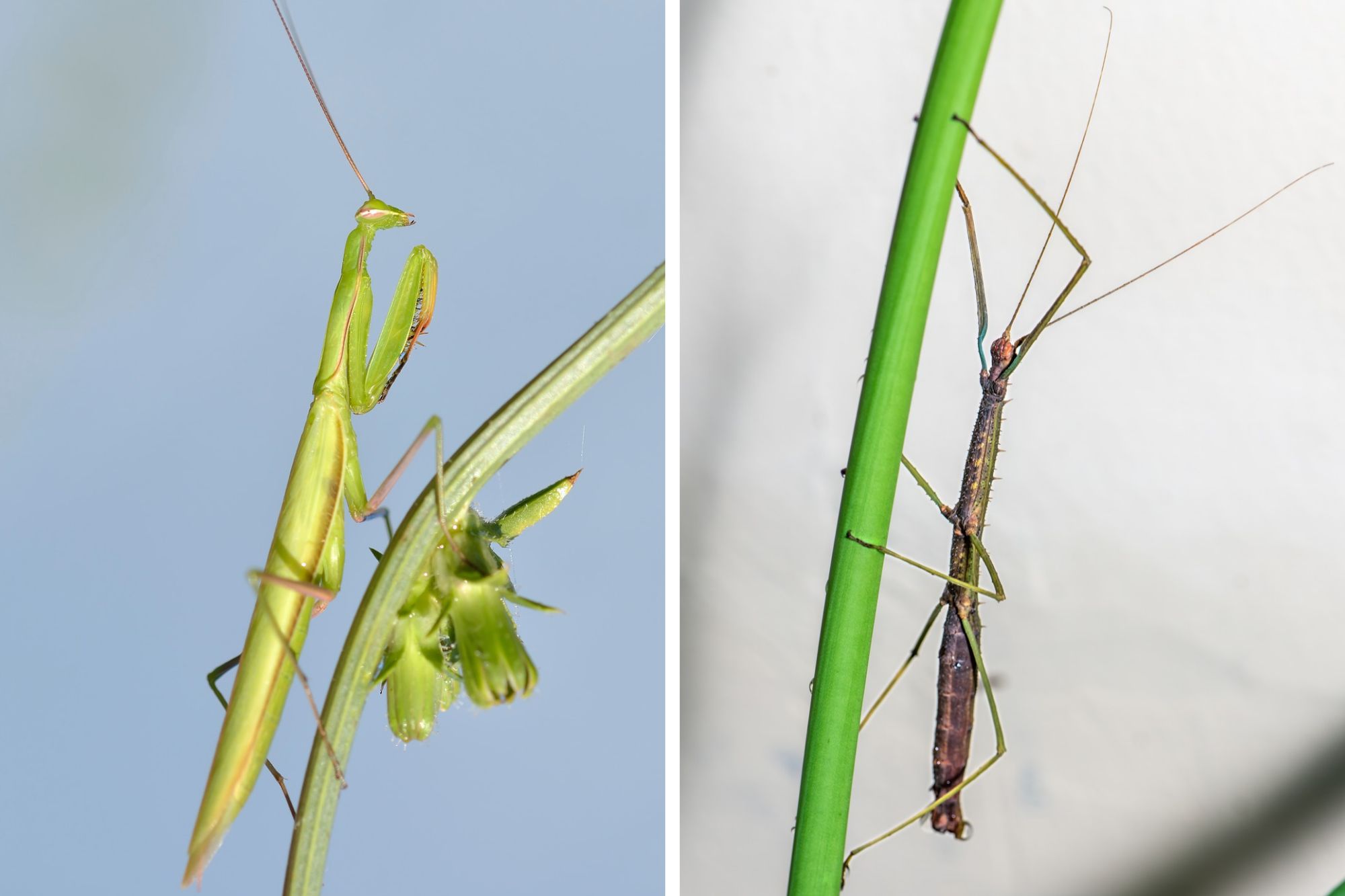
While both walking sticks and praying mantises could be confused with sticks from trees at quick glance, walking sticks bear more of a resemblance. They very clearly look like twigs and sticks, and they will even sway in the wind to better blend in, according to the wildlife federation.
Most walking sticks are green or brownish-green in color. They range greatly in size depending on the species. The smallest ones are about 1 inch long, while the largest can be more than 20 inches long!
Most praying mantises are green or brown in color, but in some parts of the world there are yellow and pink mantises that blend in with orchids and other flowers, according to National Geographic. Size can vary greatly among mantises too, but the species we see in the Midwest are generally between 3 inches and 5 inches long.
Just like walking sticks are named for their appearance, praying mantises are too. In their case, they are named for their long front legs, which are bent in a way that makes them look like they are praying. Praying mantises also have large, prominent eyes. Walking sticks don't have praying legs or prominent eyes, so these are useful characteristics for telling them apart if you aren't sure what kind of insect you are seeing.
Both walking sticks and praying mantises live across the world — on every continent except Antarctica. While both rely on their camouflage to blend in, late summer and early fall are good times to catch a glimpse of them for a few reasons. First, the insects become fully grown at this time of year, and many are also active looking for mates during this time. In addition, plant life begins to change as summer turns to fall, which can make it easier to spot the insects as they move about.