Wild Relatives: The diminutive elf owl
Editor’s note: Our Wild Relatives story series will explore the connections between our local wildlife species and related animals from around the globe. By learning about these exotic species, we hope to foster appreciation for the remarkable creatures that live in our backyards and neighborhoods.
If you spot a tiny owl here in Illinois, it's probably either a northern saw-whet owl or an eastern screech owl. But small as they may be, these owls, the two smallest in Illinois, stand much taller than the diminutive elf owl.
The elf owl is the smallest raptor species in the world, and it's about the size of a sparrow, according to the National Audubon Society. These little birds stand just 4.5 inches to 5.5 inches tall with a wingspan of up to 13 inches. They weigh between 1 ounce and 2 ounces — less than a tennis ball.
Compare that to Illinois' smallest local owl species, the northern saw-whet owl. Saw-whet owls are small by owl standards, but still larger than elf owls. They stand 7 inches to 8 inches tall with a wingspan measuring 16.5 inches to 19 inches. They generally weigh more than twice as much as the elf owl, between 2.3 ounces and 5.3 ounces.
Tiny but familiar
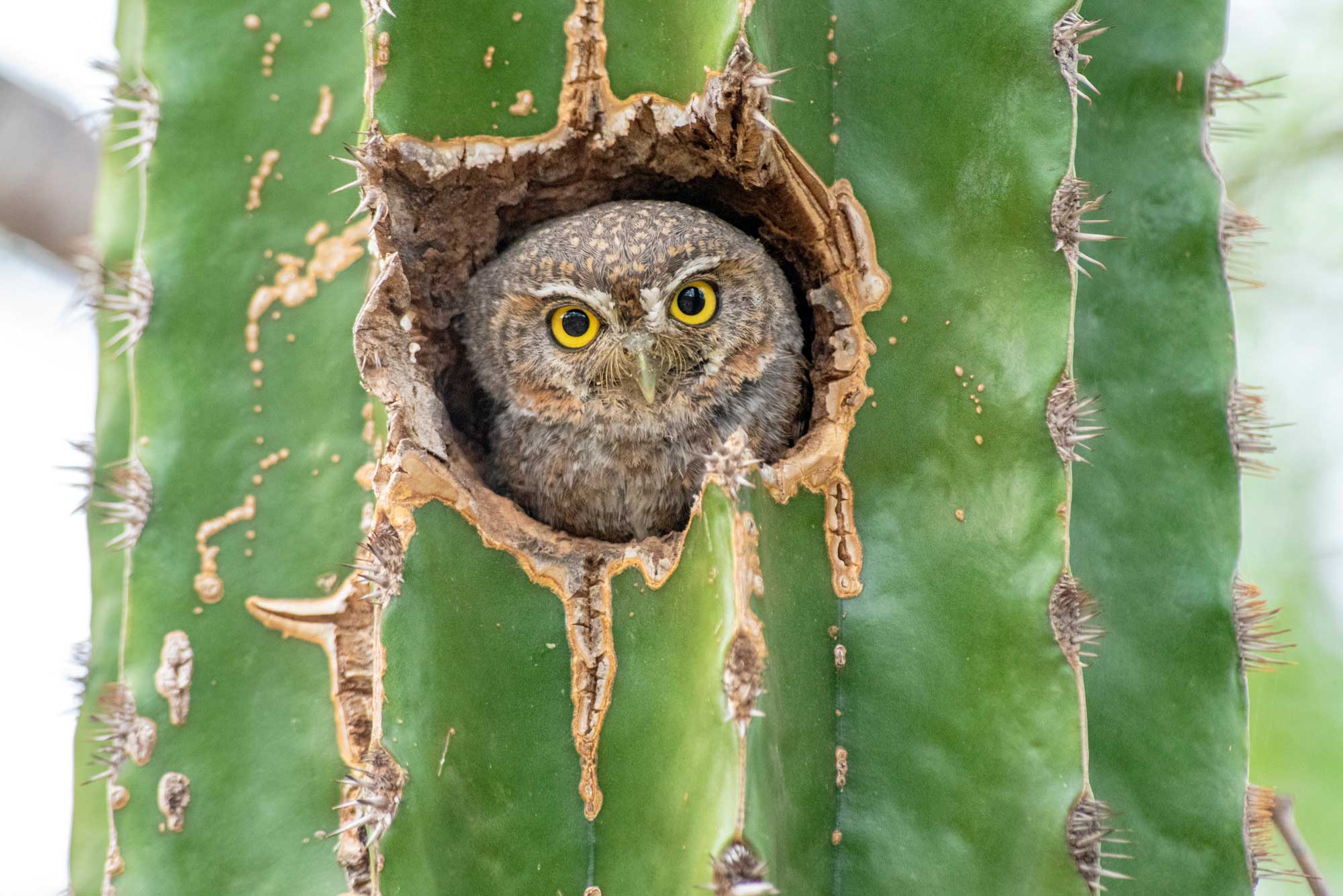
Aside from their short stature, elf owls look a lot like other owls you might be familiar with. Their plumage is mottled brown, gray, rufous (rusty colored) and white, and they have white eyebrows and a white stripe above their wings, according to HawkWatch International. Their eyes are yellow.
SEE MORE STORIES IN THE WILD RELATIVES SERIES
Elf owls have a flat, disk-like face. They do not have ear tufts like great horned owls and some other owl species, so their heads appear rounded.
Desert dwellers
We tend to think of owls as birds of the forest, and elf owls tend to fit the bill. Like some of our most common owls, including great horned owls and barred owls, they prefer woodlands, but their preferred woodlands are far from Illinois.
Elf owls live in the dry, arid climate of the southwestern United States as well as parts of Mexico, according to the Cornell Lab of Ornithology. They are migratory, but they migrate only short distances. The elf owls that spend breeding season in the Sonoran and Chihuahuan deserts in the southwestern United States and northern Mexico migrate to southern Mexico for the winter. In addition, there is a population that lives in Mexico's Baja California year-round.
Like other migratory birds, elf owls that migrate do so for access to food. In the northern parts of their range, winters are too cold for insects to be active, so they must travel south for a steady food supply, the Arizona-Sonoran Desert Museum reports.
In their range, elf owls live in a variety of woodland habitats. They typically nest in tree cavities, although they will also sometimes use holes in large cacti or nesting boxes. They also roost in tree and cacti cavities during the day.
On the hunt
Even small owls typically hunt mammals and birds, but elf owls mostly stick to hunting insects and other invertebrates, the Cornell Lab reports. Commonly hunted prey include beetles, crickets and moths along with cicadas, grasshoppers, katydids, bees, wasps, centipedes and scorpions. They also occasionally will hunt small rodents, lizards and snakes.
They will often sit on a low perch, using their keen vision and hearing to find prey below. They can snatch insects out of the air while in flight, but they also sometimes chase prey across the ground. When they catch scorpions or insects with stingers, they are able to remove the stingers before eating them. They are most active at dusk and dawn, but they will also hunt during the night.
Because of their small size, elf owls are hunted by larger owls as well as coyotes, bobcats, ringtails, snakes and more. However, they can often keep themselves safe from predators by roosting in cavities in cacti. When they are caught, they will sometimes play dead to escape danger, according to the desert museum.
They don't give a hoot
Elf owls are among the owls that don't hoot. Instead, their high-pitched song is said to sound like a barking puppy, the Cornell Lab reports. The males also use a yapping call to establish the territory around their nests.
Once paired for mating, the female will lay of a clutch of one to five eggs, although usually three. The female handles all incubation duties, sitting on the eggs for about 24 days while the male brings her food, according to the National Audubon Society.
After hatching, the male continues feeding duties, bringing food for his mate and the owlets. After a few weeks, the female will join in to help with hunting for food for the owlets. The owlets leave the nest after about a month, but the parents will continue to care for them for several more days before they can fully care for themselves.
Elf owls remain common across much of their range, but their population has been declining, according to the Cornell Lab. Among the threats to their population are habitat loss caused by development and agricultural, grazing and mining activity.