Wild Relatives: The boa constrictor
Editor’s note: Our Wild Relatives story series will explore the connections between our local wildlife species and related animals from around the globe. By learning about these exotic species, we hope to foster appreciation for the remarkable creatures that live in our backyards and neighborhoods.
Boa constrictors are among the most well-known snakes in the world thanks in large part to their portrayal in popular culture. If the movies were to be believed, boa constrictors are a major threat to people in the places where they live side by side with us.
The reality is a little different. Boa constrictors are large snakes, and they do kill their prey by wrapping their bodies around their catch and constricting it — hence the name boa constrictor. But people aren't really desired prey for boa constrictors. While they can squeeze a human, there are very few reported cases of this happening, according to the Smithsonian's National Zoo & Conservation Biology Institute.
Boa constrictors are large snakes, much larger than the snakes we see across Illinois. They can grow to be 13 feet long and weigh more than 100 pounds. Even the young snakes are about 20 inches long just after they are born. Compare that to the gopher snake, among the largest snake species in Illinois. Gopher snakes typically range in length from 3 feet to 6 feet long, according to the Illinois Department of Natural Resources. That's less than half as long as a boa constrictor.
Boa constrictors are often confused with other large snakes, namely anacondas and reticulated pythons. Boa constrictors are closely related to anacondas, which are a type of boa, according to the San Diego Zoo. Reticulated pythons belong to the python family, another group of large snakes. Both the boas and pythons are constrictors, but there are differences between them.
Pythons have more teeth than boas, and they have an extra bone in their head. And while boas live in North America, Central America and South America, pythons are native to Africa, Asia and Australia. Another difference is in their reproductive process. Boas give birth to live offspring, while most pythons lay eggs.
The squeeze is on
Boa constrictors are carnivorous — all snakes are — but they are not venomous. Instead, they kill through constricting. They start by ambushing their prey and grasping it in their sharp teeth. Then they quickly wrap themselves around what they've caught and squeeze it, the San Diego Zoo reports.
It was long thought that constrictors killed their prey by crushing their bones or suffocating them by squeezing their lungs, but that is not the case. Instead, they squeeze their prey until the heart can no longer pump blood to the brain, the National Zoo reports.
We've already established that humans — even babies — aren't ideal prey for boa constrictors, so what do they eat? Mostly lizards, birds and mammals such as rats, squirrels, opossums, mongooses and bats, according to the National Zoo. Once they catch and kill their prey, they will swallow it down whole. After a big meal, they may not need to eat again for weeks.
Boas are the most famous constricting snakes, but they aren't the only ones. Even some of our local snake species are constrictors. The North American racer and the eastern fox snake are among the local snakes that kill by constricting their prey, IDNR reports.
At home in many places
Boa constrictors mostly live in Central America and South America, but they can be found as far north as Mexico, National Geographic reports. They have the most varied habitat of all the members of the boa family, living in tropical forests, savannas, deserts, agricultural fields and more. While they can swim like their cousins, the anacondas, they prefer to stay on land. They will use abandoned burrows and hollow logs for shelter.
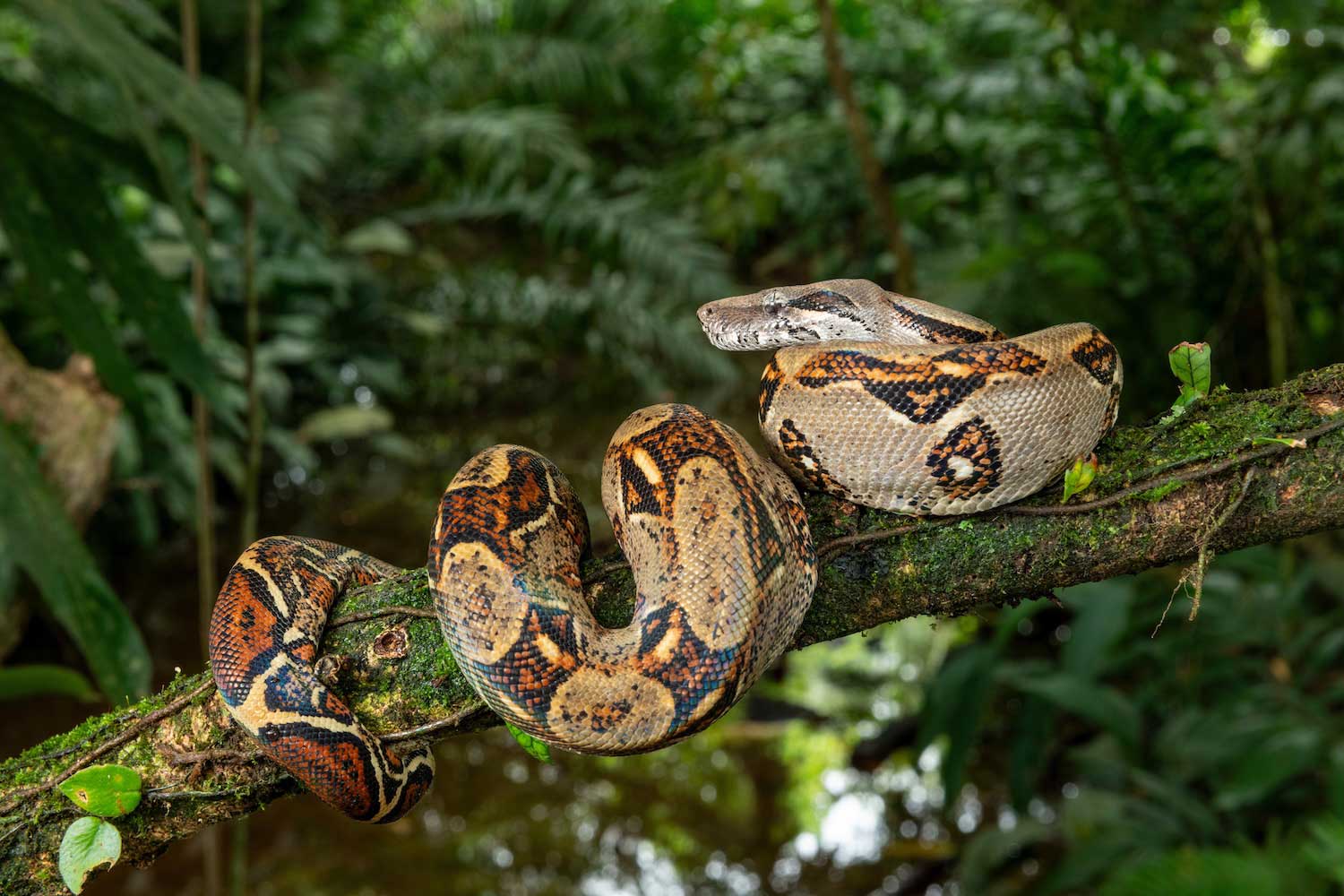
The pattern and coloring of a boa constrictor can vary depending on the snake's habitat. They can be brown, tan, green, red or yellow, the National Zoo reports. Their markings are varied, but they usually have bands that become more prominent closer to their tails.
Like many large snakes, boa constrictors move forward in a straight line rather than sidewinding, the San Diego Zoo reports. Their form of slithering is called rectilinear progression. To accomplish this, they stiffen their ribs and lift a section of their belly scales up and to thrust themselves forward. They can do this on the ground and even in trees! They don't move very fast, though. They only reach speeds of about 1 mph.
Boas around the world
Like most snakes, boa constrictors live solitary lives except for mating. They mostly live in places with wet and dry seasons, and they generally mate during the dry season, typically from April through August, Animal Diversity Web reports. Males often mate with more than one female per season, and females can have multiple mates per season as well.
Boa constrictors do not lay eggs. Instead, the females give birth to live babies that are fully developed, according to Animal Diversity Web. Females can give birth to an average of 25 babies, but litters can range from 10 to 64. The babies are independent from the time they are born. Young snakes spend more time up in the trees as they are growing, but fully grown boa constrictors spend more time on land.
The population of boa constrictors has not been assessed by the International Union for Conservation of Nature. In some parts of the world, they are hunted for their skin. They are also part of the pet trade. However, many people are unaware of how large these snakes can get, and they are sometimes released in the wild when they get too big for owners to keep. In Florida, boa constrictors are among the non-native snake species that have established breeding populations. These snakes pose risks to native species because they prey on many animals, the National Zoo reports.
While boa constrictors are not native to the United States, there are a few boa species that are: the rosy boa and the rubber boa. Rosy boas live in desert and desert-like areas in the southwestern United States, Animal Diversity Web reports. They are named for this pinkish-colored bellies, and they have three dark-colored stripes on their lighter-colored bodies. They are much smaller than boa constrictors, typically growing to be between 17 inches and 44 inches long. Rubber boas mainly live in their northwestern United States, extending as far south as southern California and as far east as Montana and Utah. Rubber boas are uniformly brown, olive, gray or rosy pink, but they have a lighter underside. They, too, are much smaller than boa constrictors, growing to be between 13 inches and 33 inches long.