One small gosling's rescue highlights a big problem in the preserves
Patti Morris was walking in one of her favorite preserves a few weeks ago when she noticed a limping gosling.
“I looked closer and it had fishing line wrapped around one ankle and its wing,” the Joliet woman said.
Morris, a frequent visitor to Rock Run Preserve – Black Road Access in Joliet, called the Forest Preserve District for help.
Forest Preserve staff contacted Chicago Bird Collision Monitors (CBCM) to see if they had a volunteer who could help.
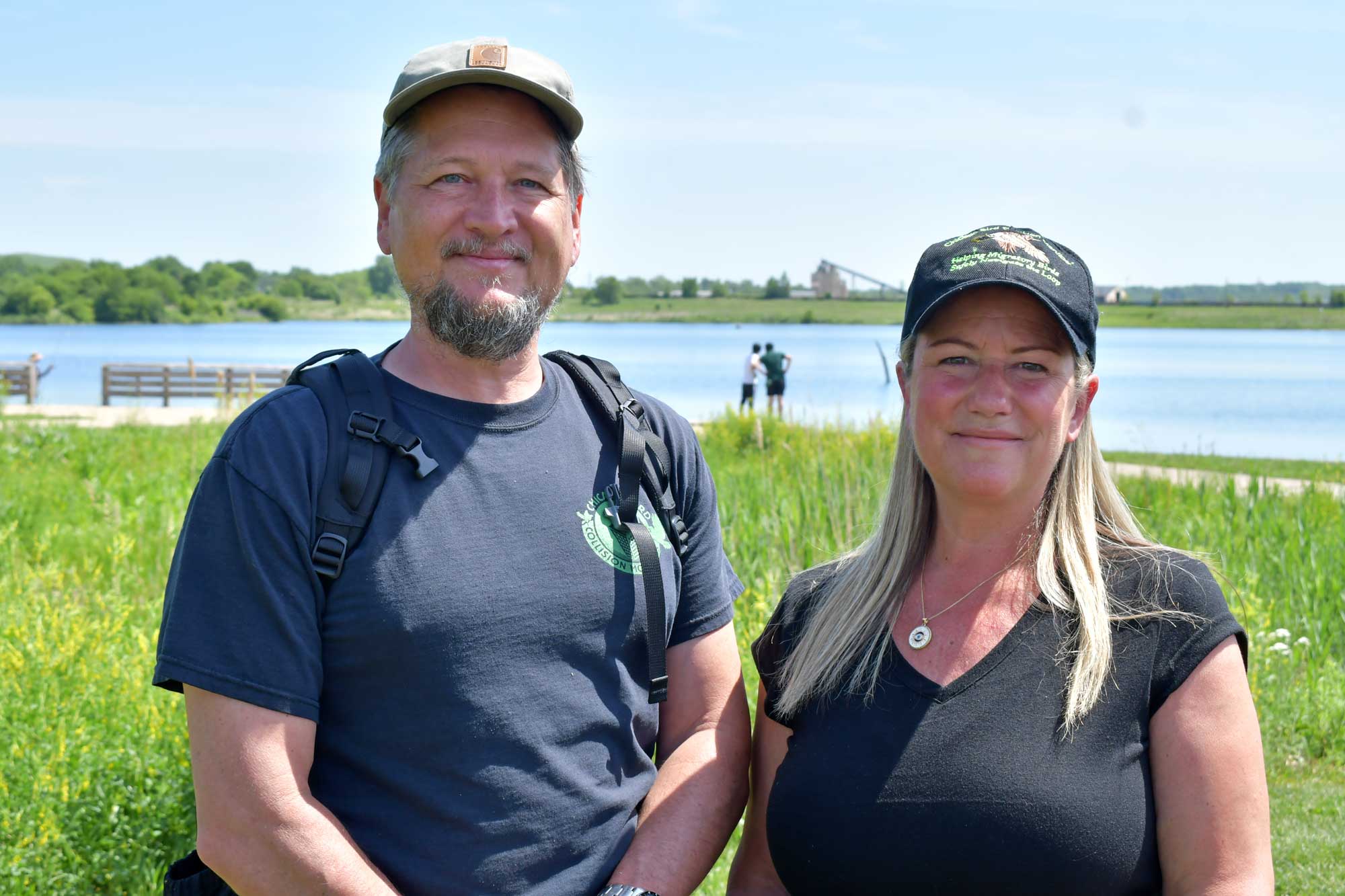
Amy Tavolino and her husband, Jerry, answered the call. Jerry sprang into action, driving from his home in Wheaton to the Joliet preserve, where he freed the gosling from the fishing line.
“It wasn’t bleeding when I took it off,” Jerry said of the fishing line. “As soon as I let him go, he ran back to his family with a limp. But he went into the water, and that is the best way for him to heal.”
Improperly disposed of fishing line, or monofilament as it’s more formally known, is a major problem in nature, and the Tavolinos are on the front lines of fighting it. They say humans cause most of the problems wildlife encounter, so they feel they have to help as much as they can.
“It is a good feeling knowing you have helped an injured bird, but it can be emotionally difficult as well,” Amy said. “Jerry and I have helped turtles, frogs, raccoons, squirrels, skunks and rabbits as well as birds.”
To combat the problem of improperly discarded fishing line, the Forest Preserve District has installed monofilament recycling containers in preserves. All the collected monofilament is recycled. Also, Forest Preserve volunteers conduct cleanup days, and the Fishing for Trash program has been extended to run throughout the fishing season.
It’s all part of a campaign launched this spring to help remove fishing line that can harm or kill wildlife in the preserves.
‘It’s their home’
Tavolino appreciates the District’s efforts and would like anglers and others to be more careful when cutting fishing line.
“The moment you leave your hooks and line lying around the shoreline or in trees and bushes, it is not a matter of if something will be injured or killed by your litter; it is a matter of when,” she said. “Something will eventually be caught, tangled or killed by your mess that you left lying around.”
She also urges preserve visitors to throw away debris they might come across.
“If you didn’t leave the mess but you see line left behind by others, pick it up. If you see a bird or animal injured from fishing line, say something,” she said. “The body of water you fish in is not yours only for recreation … it is their home. Respect where you fish, respect wildlife, and be proud to pick up and leave it clean.”
Tavolino was introduced to wildlife rescue at an early age by her mother, who volunteered at a wildlife rehabilitation center. The family also lived across from a lake that was home to geese and ducks.
“Whenever there was an animal or bird in need, my mother showed me how to help. It was common to have at least one baby bird in our laundry room that had to be fed or cared for,” Amy said.
Amy first volunteered with CBCM in 2013. The organization was formed in 2003 to help birds injured in collisions with window glass in downtown Chicago.
Since then, the group has grown to more than 100 volunteers who monitor city buildings during spring and fall migration and promote bird safety through education and outreach throughout the year, according to the group’s website. The CBCM number to call for help if you've found an injured bird is 773-988-1867.
Failure and success
Amy’s first attempted bird rescue didn’t go well. She tried to catch a goose with fishing line on its leg, but it flew away.
“I didn’t know at the time not to go after a goose with a net that is fully flighted but rather to catch it by hand,” she said. “I went back multiple times and couldn’t find the goose. A couple of months later the goose appeared in the neighborhood but had lost its leg.”
Her most heartbreaking case involved a call from a homeowner who discovered an injured goose in their yard after returning from a trip out of town.
“When I arrived at the house, which backed up to a pond, I found a goose tangled in fishing line that was attached to a bush,” she said. “The goose had broken its wing trying to free itself. Along with the goose was a dead robin that was tangled as well. The goose had to be euthanized.”
Jerry, who has been married to Amy for 28 years and says wildlife rescue is a big part of their lives, recalls a goose he tried to rescue that lost its leg due to tight fishing line.
“While (the goose) was in the net, the leg fell off, but it was still attached to the fishing line,” he said. “So, I had to put him in a carrier with the leg attached because the line was around both parts. In that case, he did get put down.”
But there have been many success stories, like the one at Rock Run Preserve.
“The most successful case has been any case where a member of the public discovers an injured bird that has a fishing line injury and we are able to cut the line (if the leg looks good) and release it back to its family,” Amy said. “Goslings are especially prone to these injuries because their legs grow so fast that any line on the leg will get tighter and tighter and the leg will fall off or they will die from infection.”
A couple of minutes a day
None of the injuries need to happen in the first place, Amy said. She urged nature lovers to think about the consequences of their actions and consider volunteering in whatever way they can.
“People should know that a couple of minutes a day walking along a shoreline picking up line and hooks will make a world of difference,” she said. “Educating friends who fish and teaching your kids who fish will help solve this problem. Fishing line recycling tubes are such an important tool to help with this problem. Having them accessible near shorelines is key. When you clean up, you are doing a good thing, and the wild world that lives alongside us will thank you.”
The Forest Preserve is appreciative of the preserve visitors who noticed injured wildlife as well as the Tavolinos and other volunteers who will drop everything to rescue these animals, said Cindy Wojdyla Cain, the Forest Preserve’s public information officer.
“To know there are people who care this much about creatures and who will take time out of their busy lives to rescue wildlife is very encouraging,” she added. “We hope the monofilament campaign gets the word out to more people so there is less fishing line in the environment harming wildlife. It would be nice to someday not have to call for help because the problem has gone away.”
As for Patti Morris, the woman who reported the limping gosling, she was happy to hear the story had a happy ending.
“I was worried that this gosling would not have a good outcome,” she said. “I was amazed and happy that there was help for this gosling.”