Wild Relatives: The coati, which might remind you of a mammal in Illinois
Editor’s note: Our Wild Relatives story series will explore the connections between our local wildlife species and related animals from around the globe. By learning about these exotic species, we hope to foster appreciation for the remarkable creatures that live in our backyards and neighborhoods.
Here in Illinois, if you see a mammal with a black masked face and a long striped tail, there's no doubt it's a raccoon. In some parts of the United States, though, there's another creature that fits the bill.
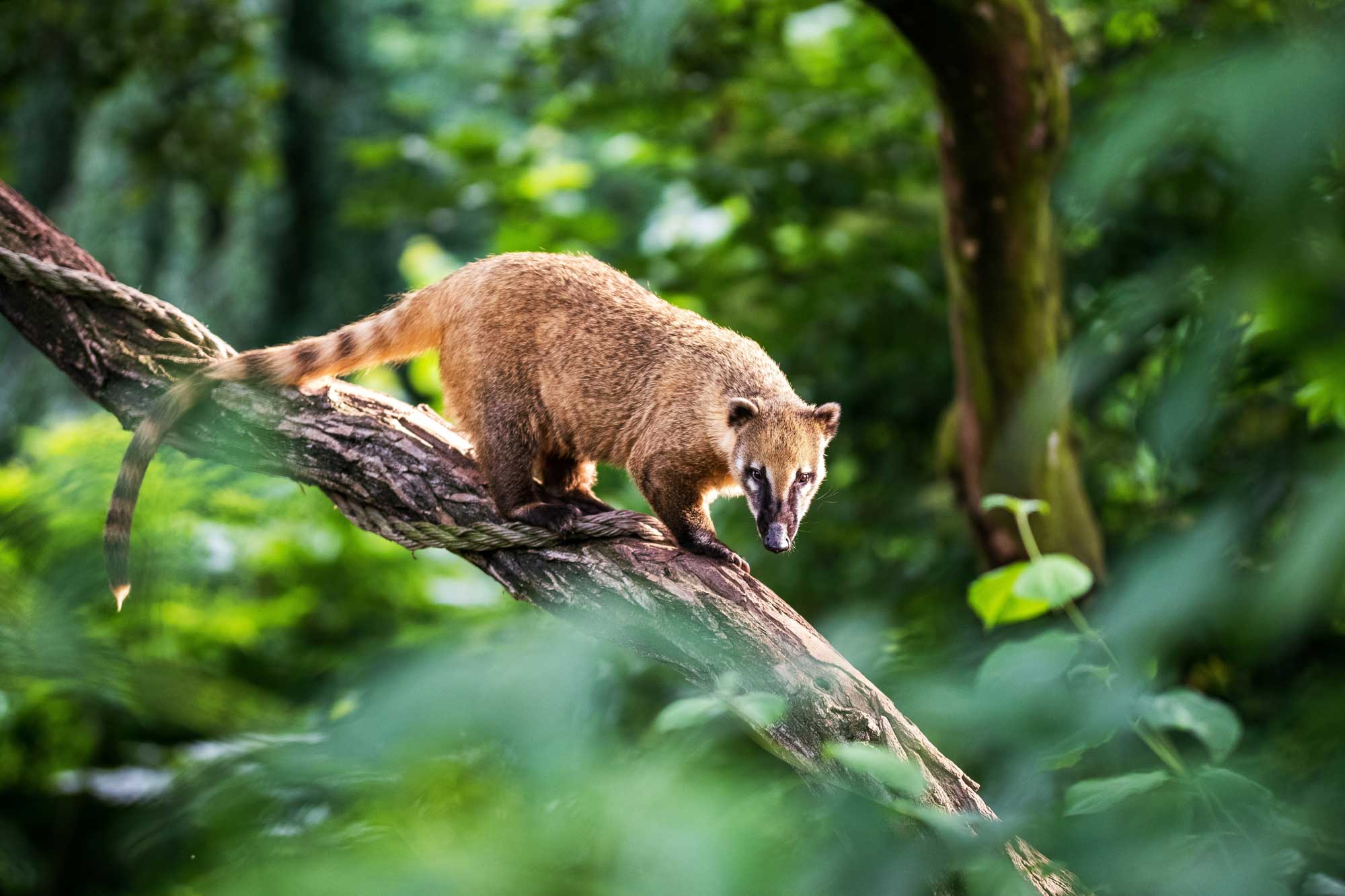
The coati also has a masked black face and a long ringed tail, and the two species are related, both belonging to the Procyonidae family of mammals. Other relatives in the family include kinkajous, olingos, red pandas and ringtails.
While coatis and raccoons do share a few key identification features, you aren't likely to confuse the two species. Coatis (pronounced koh-ah-tee) are more brown in color than raccoons, but the most obvious difference is their snouts. Coatis have long snouts that turn up at the end, like a hog's. Because of their snouts, they are sometimes called hog-nosed raccoons, National Geographic reports.
Another difference is their tails. Although both have long ringed tails, coatis' tails are much longer and less bushy than raccoons'. And coatis can use their tails in a prehensile way, helping them grip branches and balance as they move through trees, National Geographic reports. On the ground, they hold their tails up while walking, similar to a lemur.
An adaptable animal
Like raccoons, coatis are highly adaptable and can live in many different types of habitat and don't mind living near humans. They are at home in grasslands, woodlands and tropical lowlands, although they do require access to forests, the San Diego Zoo reports. They live mainly in Central and South America as well as Mexico and part of the Southwestern United States.
SEE MORE STORIES IN THE WILD RELATIVES SERIES
Coatis are omnivores, and their diet is opportunistic — they eat what is readily available to them. Sound like any other creatures you know? Coatis will eat fruit, insects, small mammals, eggs and more. They even sometimes eat carrion.
Their diet can change throughout their lives. When they are young, they often primarily eat fruit and invertebrates like insects, the San Diego Zoo reports. Older animals typically add larger animals to their diet. Males and females have slightly different hunting and foraging styles as well. Females typically hunt in groups and focus on prey they can find in the soil, like insects. Males hunt by themselves, so they are more easily able to catch rodents, reptiles and other animals.
Daytime dwellers
Unlike raccoons, coatis are diurnal, meaning they are mostly active during the day. Adult males live on their own, but females live in groups of up to 20, National Geographic reports.
These groups, called bands, include females and their young. Males reach maturity in their third year, at which time they leave the band and strike out on their own. Females often remain with their band once they reach maturity, the San Diego Zoo reports.
Males will re-enter a band during mating season, grooming the females as a way to attract one as a mate. Females also use grooming to establish relationships with other females in their band.
Females are solely responsible for raising their offspring. They are pregnant for 10 or 11 weeks, building a strong nest of sticks and leaves in a treetop during this time. They will give birth to a litter of between two and seven babies.
Several weeks after the babies are born, the females will return to their band with their offspring. The group of females then all work together to raise the babies, according to the zoo.
Four of a kind
Scientists recognize four species of coatis: the South American coati, the white-nosed coati, the eastern mountain coati and the western mountain coati. The population of all four are thought to be declining, National Geographic reports. In the case of the eastern and western mountain coatis, deforestation in the Andes Mountains where they live is the main contributor to their decline. Other factors affecting their population include vehicle strikes and expanding agricultural practices.
Coatis are preyed on by many other animals, including wild cats such as jaguars and ocelots, wolves, domesticated dogs and even birds of prey and snakes. And in some areas, coatis are also hunted by humans for both their meat and fur, and they are also captured and sold as pets, according to National Geographic.