Meet the northern harrier, a hawk with owl-like skills
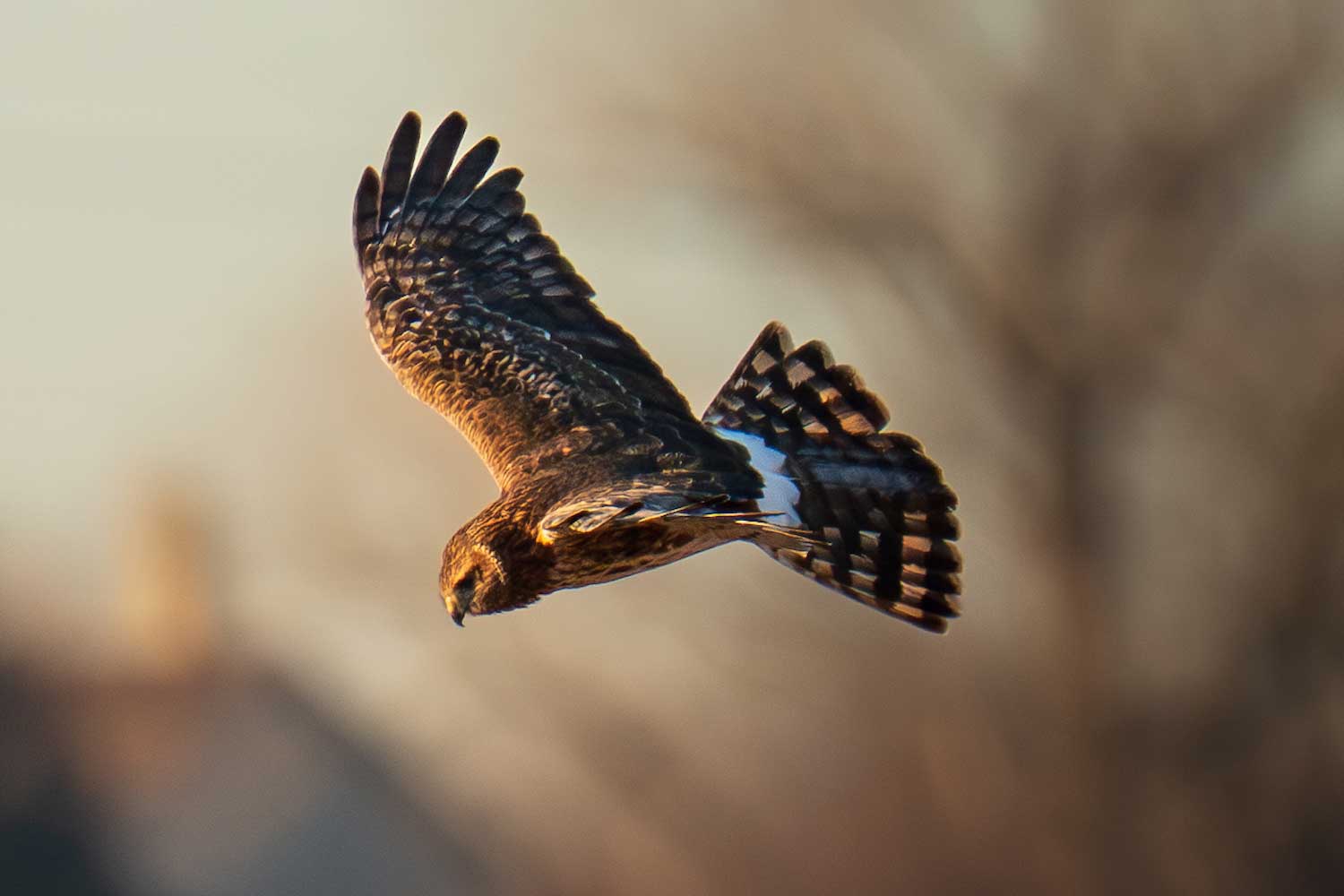
A raptor flying low over a field as it hunts could be any number of birds. It could be a hawk. It could be an owl. Or it could be a hawk that looks and acts a little like an owl.
Northern harriers are hawks, but they share a few traits with owls despite not being closely related to them. A harrier's face has a round disk shape just like an owl's, and they also hear exceptionally well and can hunt in low light conditions like many owls do.
In flight, northern harriers are easy to identify. Look for them flying low over grasslands and marshes, holding their wings in a V shape, the Cornell Lab of Ornithology reports. They have a bold white patch just above their tails that is also a key ID feature.
Male harriers are gray above and nearly white on their bellies, and they have black wingtips, the Cornell Lab reports. Females are mostly brown above with lighter colored bellies.
Northern harriers have a different hunting style than most other raptors, which typically perch high above and scan below for prey. Harriers hunt in flight, sometimes flying as low as 10 feet above the ground while scanning for a meal, according to the Outdoor Illinois Journal.
They use both their vision and hearing as they look for a meal. It's thought that their owl-like disk-shaped face can help them hear their prey better as they fly overhead.
Like many other hawks, it's mostly small mammals they are after — mice, shrews, rabbits. They will also make a meal of reptiles, amphibians, songbirds and sometimes even ducks. In the winter, harriers can subsist almost entirely on meadow voles, according to the Cornell Lab.
Harriers are migratory, but they can be found in Illinois year-round. A small number of harriers nest in Illinois, and there are also some birds that spend their winters here, according to Outdoor Illinois. Other harriers will spend their winters as far south as Central America and South America. During breeding season, they can be found throughout the northern United States and much of Canada.
When you picture a raptor's nest, you might think of a large nest high up in a tree, or maybe tucked into a cavity in a tree trunk. However, northern harriers nest on the ground, Cornell Lab reports. They will typically choose a spot surrounded by dense vegetation — grasses, cattails, sedges or reeds. The male and female both work on constructing their nest, but the female takes the lead on arranging the nesting materials.
Males often mate with more than one female a year, Outdoor Illinois reports. Females will typically lay four or five eggs and incubate them for about five weeks. During this time, the male will hunt for and bring her food.
The eggs will hatch over a couple of days, and the oldest hatchlings are most likely to survive. They will stay in the nest for about two weeks before beginning to fledge. Because they nest on the ground, harrier eggs and hatchlings are hunted by foxes, skunks, raccoons and even crows, according to Outdoor Illinois.
Northern harriers are considered a species of low conservation concern, but their population has been declining over the past several decades, Cornell Lab reports. In addition, they were included in the raptors that saw sharp declines because of the use of the pesticide DDT.
Although DDT was outlawed in the 1970s, northern harriers remain susceptible to pesticides. Habitat loss has also contributed to their population decline, according to Cornell Lab.