Invasive carp trap installed at Rock Run Rookery
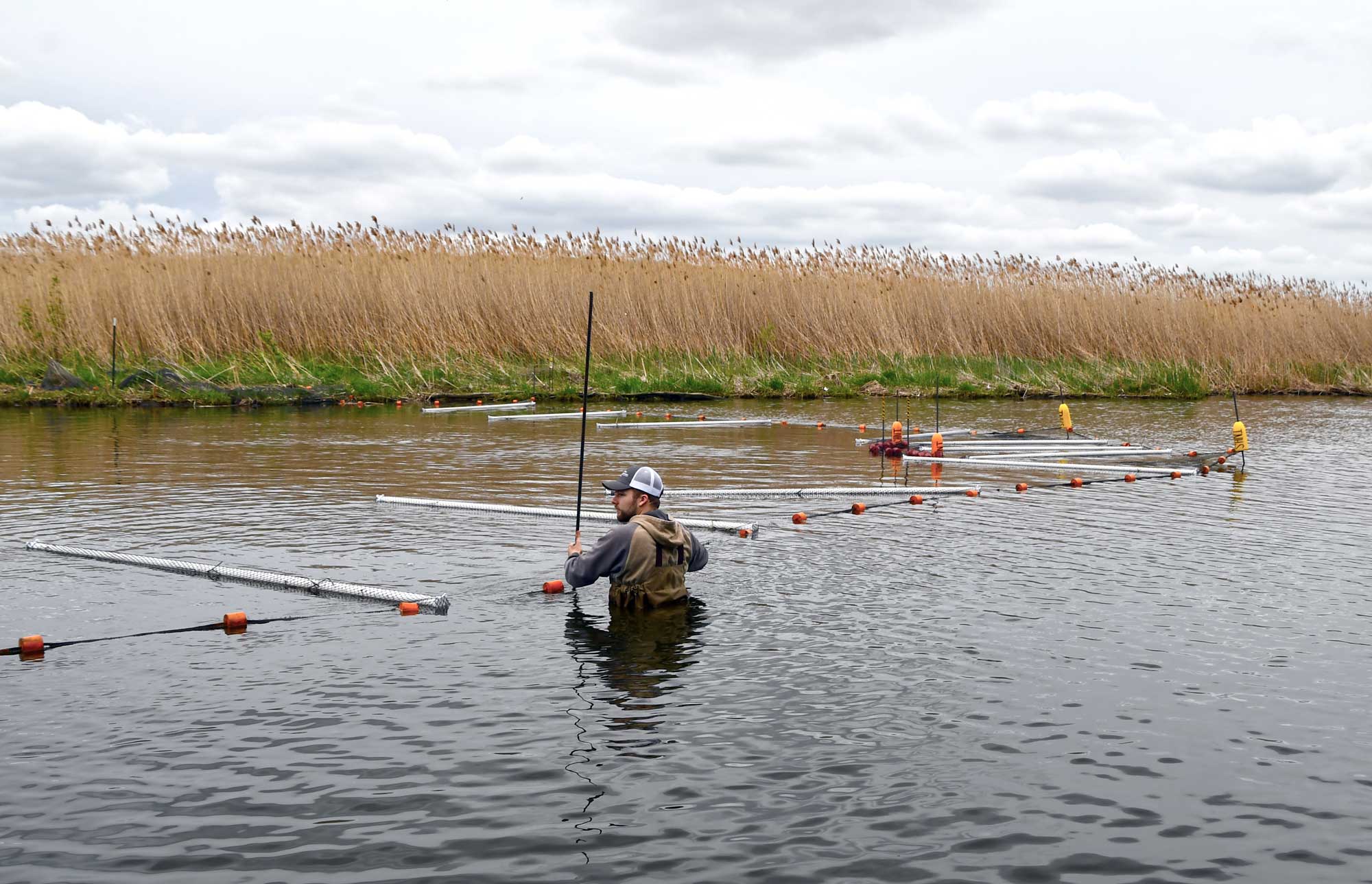
A one-way trap has been installed in a channel that links the Forest Preserve District’s Rock Run Rookery Preserve lake to the Des Plaines River as part of the battle to keep invasive carp from reaching Lake Michigan.
Invasive carp, commonly known as Asian carp, were first detected in the 84-acre former quarry in 2012. The state has contracted with commercial fishing companies to harvest and reduce carp densities in the lake since 2012 to reduce their numbers moving upstream.
Last week, a one-way trap was installed as part of a pilot program to increase those harvest numbers. The trap will funnel fish toward 9-inch-by-36-inch passages. The passages consist of gateway “fingers” made of flexible plastic that allow fish to swim in only one direction — they can enter but can’t get out. The netting is also arranged so fish can’t jump over it.
Transmitter tracking
The trap installation was overseen by James Lamer, director of the Illinois River Biological Station, and University of Illinois graduate student Cody Hagloch in conjunction with the Illinois Department of Natural Resources. The one-way trapping system is a pilot project that will be evaluated throughout the year for its effectiveness.
The nets extend about three feet below the surface, explained Hagloch, who also works as a technician for the Illinois River Biological Station. He said he will monitor the installation daily for a couple of weeks.
Carp outfitted with transmitters will be tracked through receivers to aid in evaluating the trap.
“We can determine if fish are coming in and if they are going back out,” Lamer said.
If the transmitters and the one-way trap work as intended, it will be easier for commercial companies to harvest carp at Rock Run Rookery in greater numbers. The harvested fish are used for fertilizer or the bait industry.
The invasive carp category includes bighead, silver, grass and black carp. Thirty-nine percent of the invasive carp harvested from the Dresden Island Lock and Dam region, which includes the Joliet area, come from Rock Run Rookery, Lamer said.
Lamer and Hagloch also plant to monitor whether native fish species are being kept in the lake by the trap. Adjustments could be made in future years to the trap to allow native fish to return to the river. The trap also could be set up at strategic simtes of the year when invasive carp are more likely to enter the lake.
Kayaks, canoes and small boats can still use the channel to enter the lake, but boaters will need to lift their motors to pass over the netting, and paddlers will need to glide over it, Lamer said. Signs posted at the lake entry from the channel will read: “Caution: Net in water. Trim motor.”
Perfect invaders
Lamer said the carp move into the low-current lake to rest and feed, gaining weight before leaving and heading upstream again.
After leaving the lake, the carp encounter the Brandon Road Lock and Dam, Lockport Lock and Dam, and an electric dispersal barrier on the Chicago Sanitary and Ship Canal in Romeoville, all of which block further upstream movement.
Invasive carp are always pushing upstream in search of new food sources, Lamer said, making it important to reduce their numbers at Rock Run Rookery so fewer reach Brandon Road.
If invasive carp ever reach Lake Michigan and the other Great Lakes, it is feared they could devastate native species and the billion-dollar sport fishing industry, Lamer said.
“They’re almost the perfect invader,” he said.
Some female carp in the Mississippi River have been found to produce up to 3.2 million eggs in a single batch and they are capable of spawning multiple times a year, he explained.
“So, one, they can produce a lot of offspring,” he said. “And, two, they’re planktivores.”
The amount of phytoplankton and zooplankton invasive carp species consume harms native fish that also rely on that food source, including the many species that feed on plankton in their early life stages.
In addition to the one-way trap, three other agencies continue to use the Rock Run Rookery lake to help reduce carp numbers in the river. The Army Corps of Engineers, U.S. Fish and Wildlife Service and the Illinois Department of Natural Resources all have permits to monitor and remove invasive carp from the Forest Preserve site.
Forest Preserve support
“We have been supporting these agencies and others in the ongoing effort to limit the spread of invasive carp along the Illinois River waterway (which includes its tributaries) since 2012,” said Dave Robson, the Forest Preserve District’s natural resource management supervisor.
The Forest Preserve also allowed the installation of concrete flood wall barriers on Centennial Trail in Romeoville to limit the possibility invasive carp could move upstream. The main goal is to prevent invasive carp from reaching Lake Michigan and the Great Lakes, he added.
“Current data suggests they have not moved upstream on the Des Plaines River past the Brandon Road Lock and Dam,” Robson said.
And Rock Run Rookery is a key “backwater” location for multiple agencies to monitor the carp’s upstream movement, he added.
“Over the years, thousands of carp have been removed from the lake, and therefore the ecosystem,” Robson said. “In addition to being a good collection point for the carp, it provides ready access for research on ways to improve our effectiveness managing these invasive fish.”