Field day digs into soil health at Jackson Creek Preserve
As you drive around Will County, it’s easy to see how tall the corn has grown or how healthy the soybean plants look.
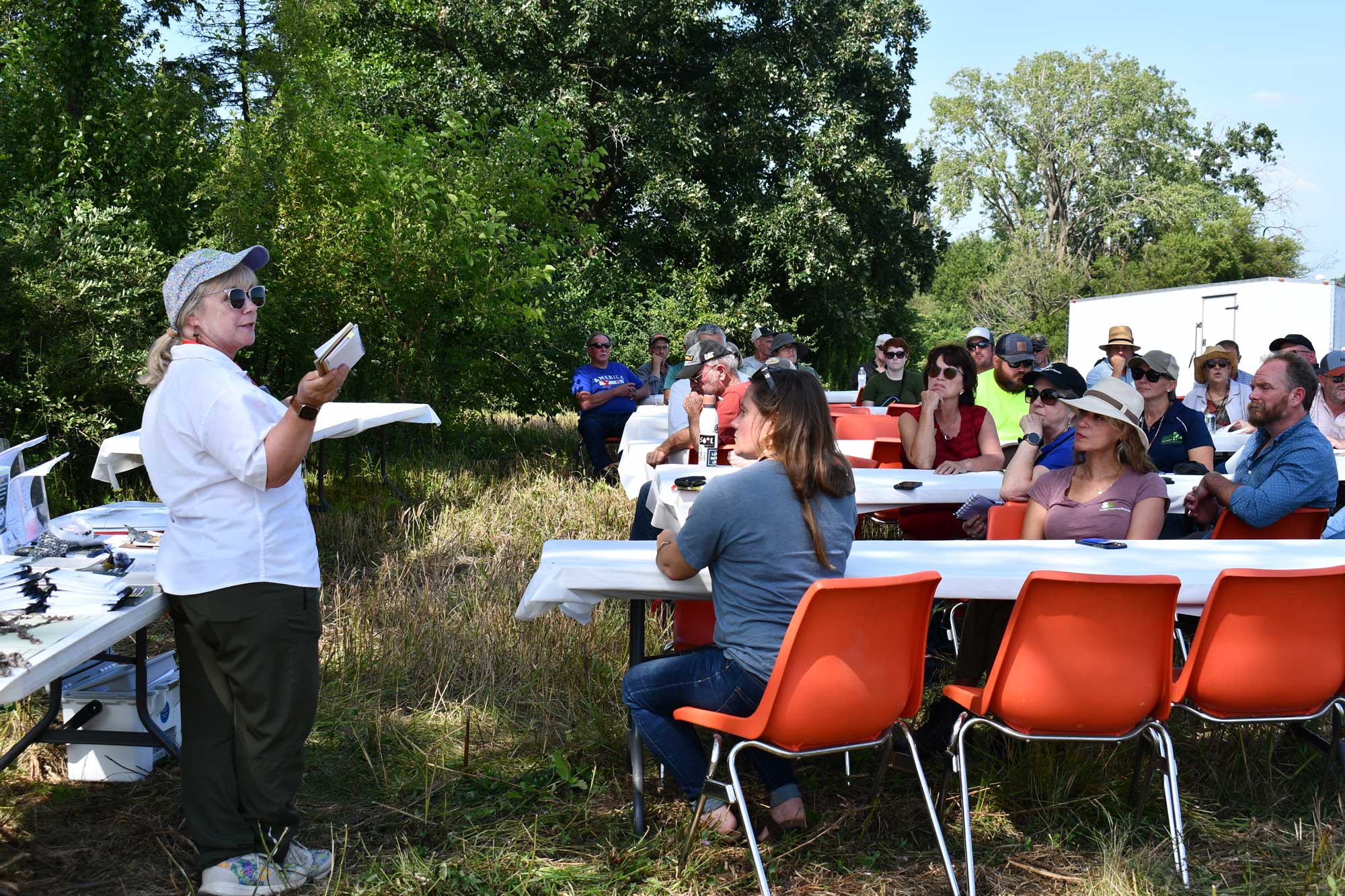
But have you ever wondered about the health of the soil beneath those plants? Farmers do. About 60 of them gathered July 30 to learn more about ways to protect the soil and crop production levels during the Will County Farm Bureau’s Nutrient Stewardship Field Day.
The event was held at the Forest Preserve District’s Jackson Creek Preserve south of Frankfort, not far from the field where the first certified organic crop on Forest Preserve land was harvested earlier in July by farmer Doug Yunker.
Field day event speakers included Dr. Andrew Margenot, an associate professor in the University of Illinois Department of Crop Sciences. He discussed the profitability of soil health, soil testing and soil enhancement practices.
Yunker spoke about his plans for crop rotation at the site and the use of cover crops. Ron Collman, Illinois State Soil Scientist, presented information on soil pits.
And Judith Wallace, the Forest Preserve’s land management coordinator, gave an overview of the District's farm license program.
After hearing about organic farming and soil health, the group climbed aboard a long hayrack pulled by a tractor for a short trip to view the organic field that Yunker leases from the District and soil pits that were dug for field day. Soil pits are used to expose the underground profile, revealing soil formation and horizons, compaction, root depth, earthworm channels and moisture-holding capacity.
‘Holding place’
Jackson Creek is one of 22 preserves where land is leased to farmers. The District leases 100 individual fields across Will County totaling 3,000 acres.
“I think the row crop and farming component of the Forest Preserve is something that maybe gets overlooked,” Wallace said. “A lot of people think of the forest preserves as parks, trails, forests, wetlands, prairies. But we also own quite a lot of agricultural land.”
The Forest Preserve owns agricultural land as a “holding place” until the District has the time and resources to restore it, Wallace explained.
“What was once prairie or wetland or woods, one day we’d like to return it to that,” she said.
Planting row crops on the land prevents invasive species and woody vegetation, including buckthorn, honeysuckle and phragmites, from taking hold.
In 2016, the Forest Preserve started reviewing its agricultural policies to find ways to improve soil health and become leaders in regenerative agriculture, Wallace said.
The policy was amended to require farmers to use no-till farming, grassed waterways, cover crops and prairie strips.
“Everything we could do to make the farms healthy, with good soil to help stop erosion,” Wallace said.
The first organic farm license was issued to Yunker in 2022 and more are coming, Wallace said.
“We are getting some interest, which is great,” she said. “We’d like to keep that movement going, if possible.”
Conventional farmers also use the techniques, which are designed to protect the soil.
“Soil health is what really matters here,” Wallace said. “If you don’t have healthy soil you’re not going to be able to grow much.”
Forest Preserve Executive Director Tracy Chapman attended the field day and said hosting it at Jackson Creek gave the District an opportunity to highlight agriculture as one of the many conservation practices used across its 24,000 acres.
“With over 3,000 acres in agriculture, including both conventional and organic farming, the Forest Preserve was excited to assist the Will County Farm Bureau with an event highlighting the importance of soil health and sustainable land management practices,” she said.