Clow family descendants: A dream of life and land across the sea came true
Sarah Clow’s last wish before she died in Scotland in 1832 was for her husband, Robert, to move to a place where all their sons could own farms.
In Scotland, only the oldest son could inherit land upon his father’s death. But in America, that was not the case.
After Sarah died, Robert acted to make her dream come true. He headed to the United States with eight of his children. The family spent several years farming rented land in New York state before heading to Illinois, where homestead farms had recently become available.
The Clows traveled by steamship from New York to Chicago and by stagecoach to Will County before settling in Wheatland Township. In the ensuing years, the Clows would expand their holdings until the family owned around 3-square miles of land.
One of Robert’s sons, Thomas, owned a farm that has been partially preserved by the Forest Preserve District as Riverview Farmstead Preserve in Naperville.
Farm life
Great-great-great nephews of Thomas' came to Will County recently to visit the 388-acre Riverview Farmstead and talk about growing up on their father's farm, which was 1 mile north of Thomas Clow’s farm.
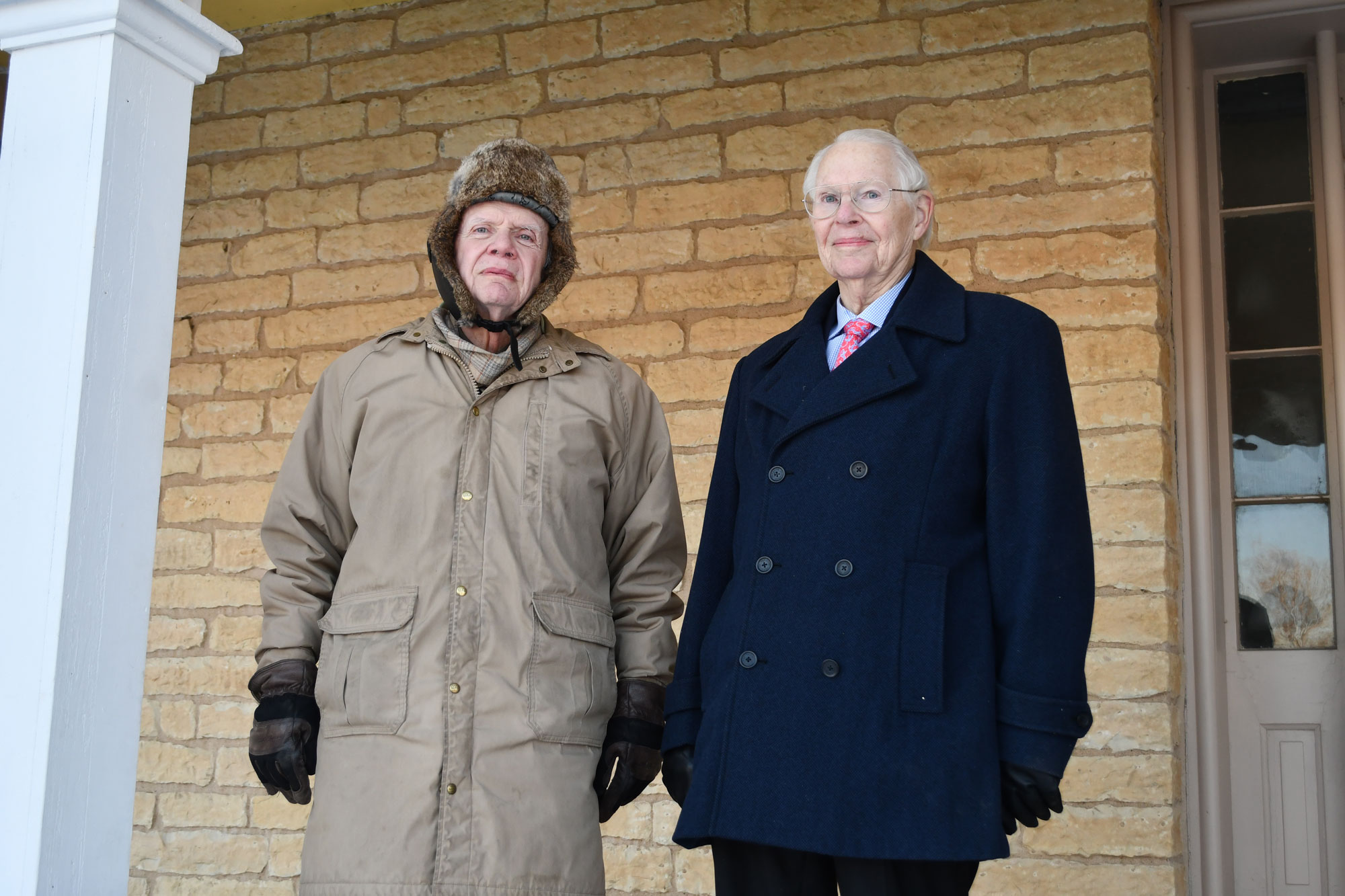
Jim Collins, 86, of Bethesda, Maryland, and Jeff Collins, 83, of Evanston, sat with Forest Preserve staff to describe what it was like growing up in a rural area in the late 1930s and 1940s.
They both attended the White School, a one-room schoolhouse in the area for grades 1 through 8. The school was small, but the education was top notch, they said, with many Clow family members who attended the school going on to earn advanced degrees.
One Clow went on to be a county clerk, another a teacher at Joliet Township High School. Their great-grandfather ran twice for Congress. And Jim became a career diplomat concluding his service as a U.S. ambassador to Russia.
Jim is the older of the two brothers and he said he was recruited early on, as were most farm children, to pitch in and help. He led the dairy cows to pasture and drove a Case tractor to pull a wagon at harvest time.
“The job that I least liked and was given early was collecting eggs from the chickens,” he said. “One thing about chickens is they don’t want you to take their eggs.”
He also did not like pulling weeds in the hay fields.
“It was hot, it was not fun,” he said.
Growing up on a farm made kids more self-sufficient, Jim said. You didn’t just pick up the phone to call someone else for help. You fixed it or built it yourself.
“Self-sufficiency is very much something that is ingrained,” Jeff said.
In the early years, the family used a McCormick reaper to cut and shock oats and a threshing machine to separate grain from straw. Until the mid-1930s the outhouse was a two-hole privy, there was no indoor plumbing, and toilet paper came from National Geographic and the Sears catalog.
Electricity came to the farm in 1936, and little by little the old ways faded into the past.
Because Jeff is younger, he has fewer farm memories because the boys’ father, Harrison, landed a job as a school superintendent in Northfield and they would move there to live and build a house eventually.
Food and animal stories
During the farm’s productive years, the Clows grew oats, corn, hay and soybeans. They had dairy cows and beef cattle. And they sold produce, butter and eggs in town.
Food memories were abundant. The brothers remember going into town in Naperville for treats. Sometimes it was ice cream, other times popcorn, a family favorite.
And their grandmother’s baking powder biscuits were the best. The biscuits were used in chicken and dumpling dishes and strawberry shortcake. There also was elderberry pie, something you don’t see much of today, Jim lamented. “People think it’s a weed,” he said.
Animals also were a big part of farm life. The Collins brothers said if you watch the movie “Tom Jones,” you will see that Scottish people love to name their animals. The Clow horses were named Clark Gable and Gary Cooper. And there was a parakeet named Doc and a Belgian shepherd they called Whimpy.
“They respected them, and they were members of the family,” Jeff said of how the Clows treated their animals.
Their mother once fed an orphaned raccoon, which became a pet until the family released it into the wild. And she did the same with the only piglet to survive in a litter. But that, too, was sent outside once it reached 300 pounds.
At one point, there were four generations of Clows on the farm. And because it was confusing to say mom or dad, “I called my mother Caroline and my father Henry,” Jeff said.
Many of the families that lived in the area came from Scotland and Germany, and they intermarried, Jeff recalled.
“Both the DuPage Presbyterian Church and the United Presbyterian Church were originally Scottish,” he said. “The latter was known as the Scotch Church. And the (annual) Plowing Match was patterned after a similar celebration in Scotland.”
Irreplaceable and invaluable
The Collins brothers have many heirlooms, and they plan to donate some items to the Forest Preserve District, including a spinning wheel crafted by James and Thomas Clow in the 1800s.
Jeff is still using a Civil War-era bed and he has a clock purchased in New York in 1840.
“This clock still keeps time,” he said.
Other items include furniture, pots, dishes, clothing, photos and the written recollections of their mother, who grew up on the farm.
The land owned by their great-great-great-grandfather Robert — who was born in 1787 in Ecclefechan, Scotland, and died in 1870 in Wheatland Township — is now a subdivision. So, seeing a portion of Thomas Clow’s farm and buildings preserved at Riverview Farmstead, “is just magnificent,” Jeff said.
And Riverview protects a good example of the homesteading era, he added.
“It’s a reminder of where the whole area comes from because there’s not much of it left,” Jim said.
“The Riverview Farmstead is an irreplaceable and invaluable historic landmark and monument to generations of farmers and families who developed a substantial part of northern Illinois,” the brothers wrote in a post-visit email.
The preserve also serves as a monument to an extended family that farmed land from 1844 through the 20th century, they added.
“The Farmstead in this capacity provides visitors some insight into a world that created the culture they know today, and we hope engaged them in thinking about the role families like the Clows had in building the communities where they now live.”
In the final decades of the Clow family’s farm ownership in Wheatland Township, parcels were sold and there were some family disputes.
Jim said the Clow family’s golden years of farming really lasted about 100 years until 1959 when his grandfather Frank still farmed some of the land.
The land went from prairie to suburb, “with a slight intermission of a century of farming,” Jim said.
‘It really happened’
The Collins brothers say they are appreciative that they know so much about their ancestors when many people do not.
They grew up with three generations of Clows and relatives on their mother’s side. The brothers say they inherited, “curiosity, being interested in different things, not thinking anything is really beyond your reach necessarily."
And the family name lives on in the area, not only at Riverview Farmstead, but in names of local places including Clow International Airport in Bolingbrook, Clow Creek, Clow Elementary School and Clow Creek Subdivision.
On a broader scale, the Collins brothers said they also watched their little patch of land in Will County transform along with the nation from a mostly rural society to a country with big cities and suburbs and less and less farm living.
“This is a whole era that has come to a close,” Jim said.
In the end, the Clows would flourish on the land and they are proud of their heritage, he said.
The family made Sarah’s dream come true and the Clow sons who had families were able to own their own farms.
“It really happened,” Jeff said. “I’m proud of that.”