Wild Relatives: The leatherback sea turtle
Editor’s note: Our Wild Relatives story series will explore the connections between our local wildlife species and related animals from around the globe. By learning about these exotic species, we hope to foster appreciation for the remarkable creatures that live in our backyards and neighborhoods.
Turtles come in many shapes and sizes, but none grows as large as the leatherback sea turtle, which can weigh as much as 2,000 pounds and grow to be 7 feet long!
How does that compare to our local turtles? The largest turtle we see in northern Illinois is the common snapping turtle, which can weigh between 10 pounds and 35 pounds. Our most common Illinois turtle, the red-eared slider, can weigh as much as 7 pounds. So leatherbacks weigh more than 50 times as much as a snapping turtle and more than 280 times as much as a red-eared slider.
Appropriately named
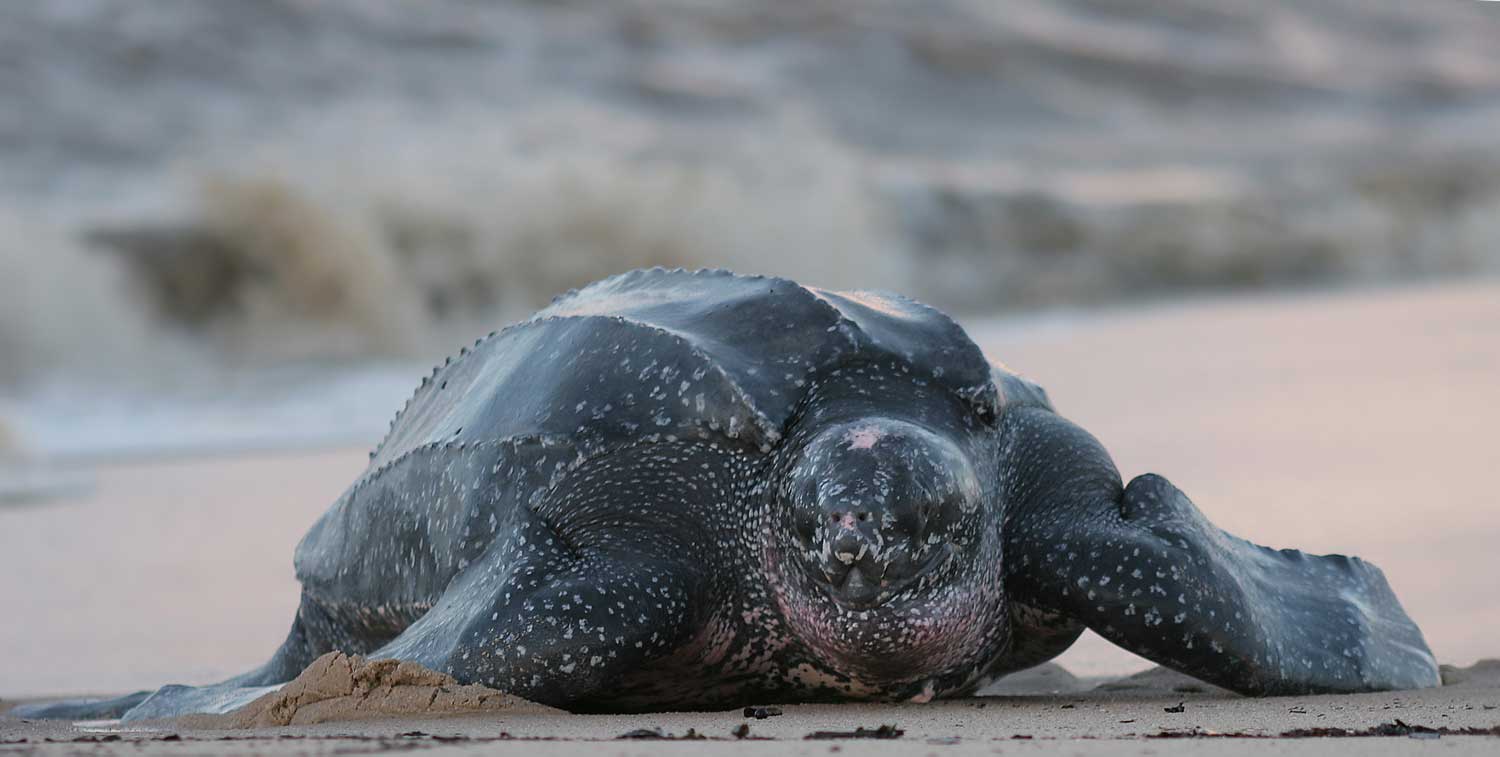
Size isn't the only thing that sets leatherback sea turtles apart from most of our local turtle species. Leatherbacks also don't have the hard protective shells turtles are known for. Instead, they have rough leathery shells, according to the National Park Service. In this way, the huge sea turtles are like the softshell turtles we see locally — the spiny softshell turtle and the smooth softshell turtle.
Leatherbacks are mostly black in color. Their leathery shells don't have scales, called scutes, like hard-shelled turtles. Their shells are made of small interlocking bones, and the top of their shell, called a carapace, has seven long ridges that run from one end to the other, ending in a blunt point, according to the National Oceanic and Atmospheric Administration (NOAA).
SEE MORE STORIES IN THE WILD RELATIVES SERIES
The ridges on their shells make them hydrodynamic, which helps them dive deeper in the water, National Geographic reports. They can dive deeper than any other sea turtles, staying underwater for as long as 85 minutes and reaching as far as 4,200 feet below the surface. That's just a little less than three times as tall as Chicago's Willis Tower!
A specific diet
Leatherback sea turtles are gelatinivores, which means they predominantly eat soft-bodied aquatic animals, according to the U.S. Department of the Interior. Specifically, their main food source is jellyfish and sea squirts, also called tunicates. They will also occasionally eat seaweed, crustaceans and fish. Their throats have spine-like structures that face downward, which allows them to swallow slippery jellyfish and other prey without them coming back up.
They can consume almost their entire body weight in jellyfish every day, and their massive consumption of them plays an important environmental role. By controlling the jellyfish population, they also help control the population of zooplankton, which jellyfish eat. This helps keep ocean food webs in balance.
Like other sea turtles, leatherbacks migrate between their breeding grounds and feeding grounds, and they travel as far as 3,700 miles each way — farther than any other sea turtle species, National Geographic reports.
The male and female mate in the water, and the female will come on shore briefly at night to dig a nest in the sand, lay about 100 eggs and then fill the hole with sand. The eggs incubate for about two months before the tiny hatchlings emerge.
Whether the turtles develop as males or females depends on the temperature inside the nest, according to National Geographic. When a nest is about 85 degrees Fahrenheit, a combination of males and females will hatch. When the nest is colder, the turtles develop as males. At higher temperatures, the hatchlings will be female.
Leatherback turtles spend nearly their entire lives in the ocean. They hatch on land and then quickly make their way to water. Once in the sea, males will spend the rest of their lives in the water. The females come ashore only to nest and lay eggs, the NOAA reports. Their life expectancy isn't fully known, but it is thought that they can live 45 to 50 years or possibly longer in the wild.
An expansive but declining range
The leatherback is the most widely distributed reptile species in the world and at one time lived in all the world's oceans except the Arctic and Southern (Antarctic) oceans, NOAA reports. And while these sea turtles continue to have an expansive global range, living in the Atlantic, Pacific and Indian oceans, their population has plummeted. Today they are listed on the U.S. Endangered Species List.
According to estimates, the leatherback population has declined by about 40% over its previous three generations. The turtles face threats both on the beaches they rely on for nesting and in the oceans. The most significant threats include loss of nesting habitat, being captured or trapped in fishing gear, hunting and egg collection for human use, according to NOAA. Other threats include ocean pollution, strikes by watercraft and changing climate and environmental conditions.
Leatherbacks that live in the Pacific Ocean face the most significant threats and are at greatest risk of extinction, according to the NOAA. The Pacific population of leatherbacks has declined by a staggering 90% over the past three generations.
You can help protect leatherback sea turtles and other marine life in many ways. First, keep a distance and admire these creatures from afar so as not to disturb them. If you encounter sea turtles and other marine life in distress, contact professional responders.
The NOAA also recommends these additional steps you can take to help protect sea turtles:
- Reduce marine litter by participating in cleanup events and responsibly disposing of fishing line.
- Reduce your use of plastic.
- Do not release balloons outdoors.
- Do not drive on beaches where sea turtles nest.
- Remove beach equipment (chairs, umbrellas, etc.) when you leave the beach.
- Knock down sand castles and fill in holes when you leave the beach.