Wild Relatives: The caribou, or do you call it a reindeer?
Editor’s note: Our Wild Relatives story series will explore the connections between our local wildlife species and related animals from around the globe. By learning about these exotic species, we hope to foster appreciation for the remarkable creatures that live in our backyards and neighborhoods.
Ready for some reindeer games? Let's start with this guessing game: What's the other name for a reindeer? Give up? It's caribou.
That's right. Reindeer and caribou are two names for the same animal, much like groundhog and woodchuck refer to the same animal. In North America, the term caribou is the more common term, while reindeer is more commonly used for the Eurasian populations of these animals from the deer family, according to the San Diego Zoo. However, when the animals are domesticated, we call them reindeer, no matter which continent they live on. Both caribou and reindeer have the same scientific name, Rangifer tarandus.
Caribou and reindeer live in the Arctic and in the tundra and boreal forests of northern North America as well as Greenland, Europe's Scandinavia, Russia and parts of northern Asia. No matter what you call them, these animals are part of the cervid family, which also includes the white-tailed deer that is familiar across Illinois.
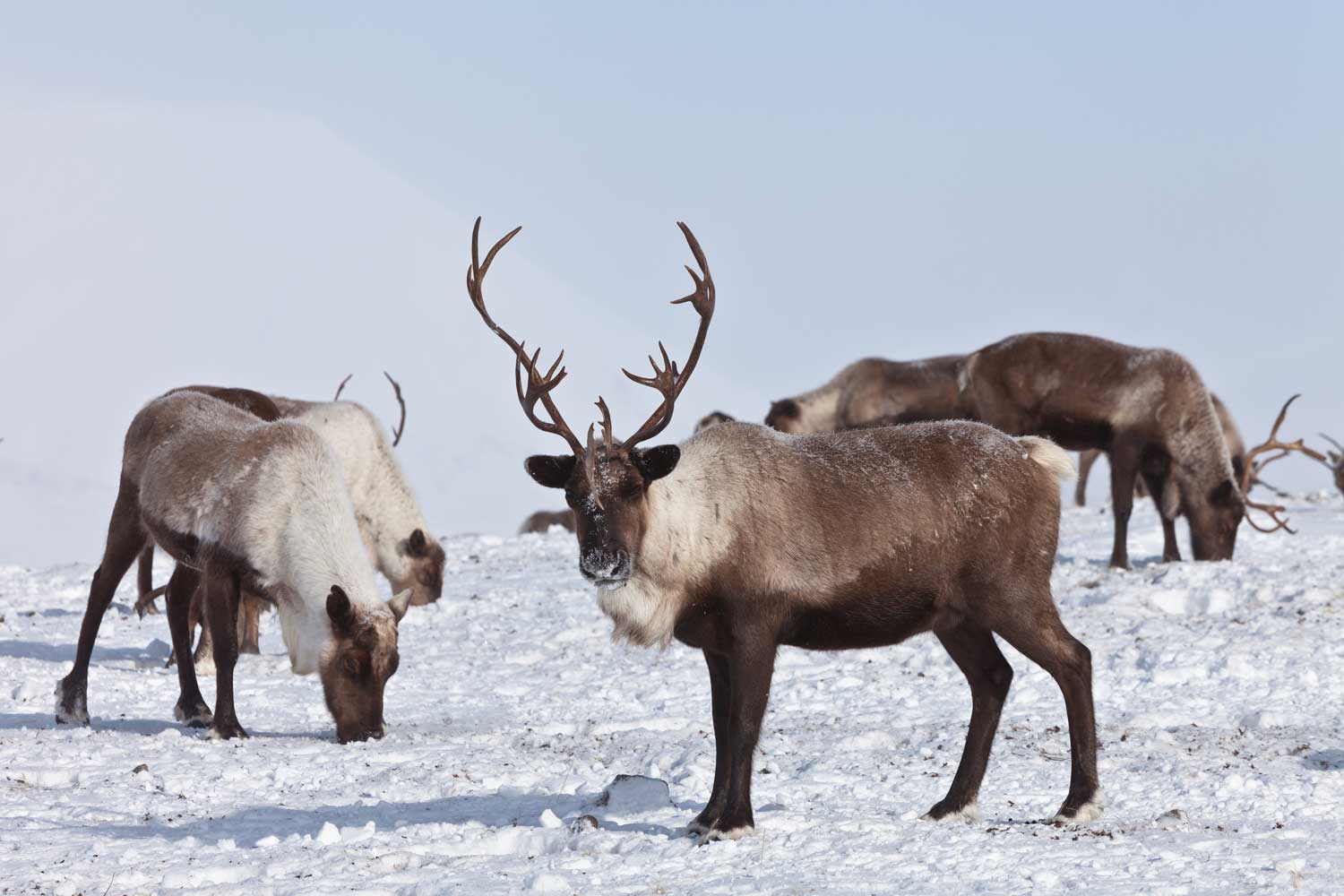
Cervids are hooved mammals with four-chamber stomachs. Among cervids, the males of nearly all species grow antlers. However, caribou are an exception to this rule because both male and female caribou grow antlers. They are the only cervid species in the world in which both sexes grow antlers, National Geographic reports.
A caribou's antlers can get very large! They grow the largest and heaviest antlers of all cervids in relation to their body size. Males grow larger antlers than females. A male's antlers can be 51 inches long — more than 4 feet! Females' antlers can grow to be about 20 inches long, the San Diego Zoo reports. Both males and females use their antlers to their advantage when battling predators. Males also use their large racks to attract potential mates, and females will push snow with their antlers so they can get to food underneath.
Just like white-tailed deer, male caribou shed their antlers after mating season, usually in November. They will start growing a new pair around February, according to National Geographic. Female caribou also shed their antlers, but not until spring. That means the most famous reindeer of all — the ones pulling Santa's sleigh — must be female because otherwise they wouldn't have their antlers at Christmastime.
Caribou are much larger than white-tailed deer. They stand between 4 feet and 5 feet tall at the shoulder and weigh between 250 pounds and 700 pounds. White-tailed deer typically stand between 3 feet and 4 feet at the shoulder and weigh between 125 pounds and 300 pounds. The color of a caribou's fur can vary by location. Most have brown fur, but in some areas they are mostly white. Their fur is typically darker in the summer and lighter in the winter.
Winter warriors
Caribou live their lives in cold climates. Even in the summer, they don't experience hot temperatures like we do in Illinois. They have several adaptations that help them survive in frigid weather. For starters, they are almost entirely covered in fur. Even their hooves are covered in fur. This helps with grip on muddy, snowy or even icy surfaces, according to the San Diego Zoo.
Their noses are even adapted to the cold. They are the only deer species that has fur entirely covering their nose. As they breathe in cold air, their noses warm it up before it gets to their lungs. Their noses also allow them to find food that might be hidden under a layer of snow.
Like our white-tailed deer, caribou shed their fur before winter, growing in a thicker coat to help them stay warm. Their winter coats have two layers, a woolly base layer and a top layer of hollow guard hairs. These guard hairs fill with air that is warmed by their body heat to help protect against wind and cold. Because they are hollow, the guard hairs also help reindeer float, making it easier to cross water, the San Diego Zoo reports.
Migrating mammals
When we think of animals that migrate, birds first come to mind, and maybe insects too. But there are a few mammals that migrate, and caribou are one of them. They spend their summers on the arctic tundra, but they will head south when the weather begins to turn as winter sets in. The females leave first, and males will follow a few weeks later with the calves that were born that year, National Geographic reports. Some caribou will migrate as far as 800 miles one way, sometimes covering as much as 50 miles a day.
Caribou are herd animals. They migrate with a herd and spend their lives with other caribou. In the spring, herds will sometimes merge for a time, creating massive herds that can number into the hundreds of thousands, the San Diego Zoo reports.
Even when they aren't migrating, herds stay on the move so they have access to food. They are grazers, eating a lot of grasses, mosses, herbs, ferns and shoots and leaves from trees and shrubs. They will also eat lichen and fungi, particularly in winter when other food sources are more scarce. Caribou eat throughout the day and can consume between 9 pounds and 18 pounds of food each day, according to the zoo.
A species at risk
Like with white-tailed deer, mating season for caribou is in the fall. The necks of the males will begin to swell and they will grow a mane around their necks in September as a way to attract female mates. Males often battle with other males for the females' attention, and the winners will select between five and 15 partners to mate with, the San Diego Zoo reports.
Caribou calves are born in the spring. Just before birthing season, the pregnant females will leave their herd to travel to the group's calving ground. All the calves are born over the course of about 10 days, typically in May or June.
Females usually give birth to just one calf at a time, although twins and even triplets are not unheard of. Among white-tailed deer, it's most common for females to give birth to twins. Caribou calves are able to follow their mothers just five to seven hours after they are born. The calves grow quickly, adding solid foods to their diet after about a week and then being fully weaned when they are about 6 months old.
Today, caribou are considered vulnerable to extinction, National Geographic reports. The worldwide population of caribou is estimated at about 5 million. Of these, about 750,000 live in Alaska, according to the state's Department of Fish and Game. Alaska is actually home to more caribou than people, with a human population of 733,391 in the 2020 census.
Caribou face many threats in the wild. In some areas, logging activity makes them more likely to be hunted by predators like wolves and bears. Because they migrate, they are also affected by human activity, such as development and industrialization, along their traveling routes, according to National Geographic.
Climate change is a major threat as well. As the Arctic terrain changes with the climate, the white-tailed deer has started to expand its territory north into areas populated by caribou and moose. The deer pose serious risks in these areas because they can carry a parasitic worm that is fatal to caribou and moose, the San Diego Zoo reports.