Wild Relatives: The bearded vulture
Editor’s note: Our Wild Relatives story series will explore the connections between our local wildlife species and related animals from around the globe. By learning about these exotic species, we hope to foster appreciation for the remarkable creatures that live in our backyards and neighborhoods.
Vultures are most known for both their unique appearance and their unique diet. These birds won't win any beauty contests, and their steady diet of animal carcasses isn't that common in the animal kingdom either.
However, there's one vulture species — the bearded vulture — that takes things a bit farther on the food front. Like other vultures, bearded vultures feast on dead animals, but there's just one part of the carcass they are interested in — the bones. That's right, these vultures primarily eat bones!
A bony diet
Eating mostly bones might seem like an odd choice, and it is. Bearded vultures are the only bird in the world that mostly eats bones, according to the National Audubon Society. They have a very acidic digestive system that breaks down the bony material so the birds can benefit from the fat and nutrients inside.
Bearded vultures, which are also called lammergeiers, often eat bones of very large animals, including deer, cattle and sheep. They can pick up bones more than a foot long and then fly up into the sky before dropping the bones to the ground below, allowing them to break into smaller pieces that are easier to eat.
While the vultures primarily feast on dead animals, they can hunt live animals, relying on the same technique of lifting their catch up into the air and allowing it to drop down to make it easier to eat, Animal Diversity Web reports. While as much as 85% of an adult bearded vulture's diet consists of bones, the chicks eat more flesh and meat as they mature and grow.
Old World vs. New World vultures
Bearded vultures are related to the turkey vultures that we see soaring overhead here in Illinois, but they are classified as a different type of vulture. Our familiar turkey vultures are New World vultures, which are characterized by their bald heads, according to the San Diego Zoo. Bearded vultures are Old World vultures, and these birds don't have bald heads. Instead, they look more like some of their raptor relatives, including eagles and hawks.
New World vultures are found in North America, South America and Central America, while Old World vultures live in Africa, Asia and Europe. Another difference between the two families of vultures is how they vocalize. New World vultures can hiss and grunt, but they don't otherwise make much noise. But bearded vultures can be loud, even screaming in flight while trying to attract a mating partner.
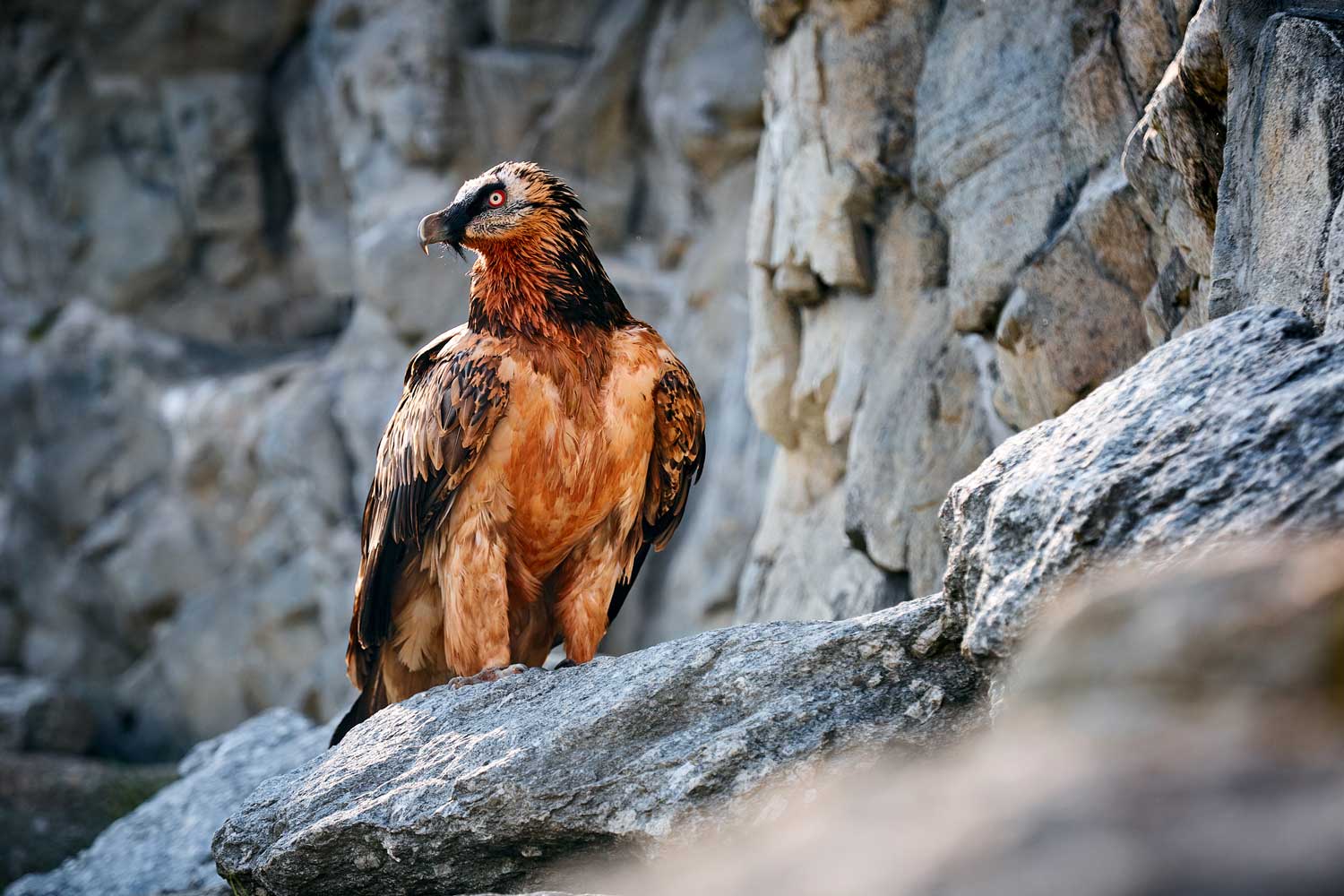
Even without bald heads, bearded vultures are an unusual looking bird, and it's partly by choice. These large birds have dark wings and backs and goatee-like beards for which they are named, but another unique feature is that their heads, chests and legs are often a reddish orange color that they dye themselves. They acquire this reddish hue by bathing themselves in rusty water or red soil, the BBC reports. If not for their dye jobs, these reddish parts would be white.
They are the only birds in the world known to change their color intentionally, and the reason they dye their feathers isn't entirely understood, according to the BBC. Some believe they coat their feathers in iron oxide, which is where the color comes from, as a way to kill microbes. Another theory is that the bright color is meant to signal the birds' health and fitness to other birds and can be used to intimidate other vultures.
As is the case with many raptors, female bearded vultures are larger than males, according to Animal Diversity Web. The birds can weigh between 9 pounds and 15 pounds and have wingspans of between 8 feet and 9 1/2 feet.
Mountain birds
Bearded vultures typically live at high elevations across mountain ranges in Africa, Asia and Europe, Animal Diversity Web reports. They most often choose to live in remote areas with rugged terrain such as cliffs and gorges that overlook meadows where they may find animal carcasses to feed on.
Bearded vultures do not reach maturity until they are between 5 and 7 years old and may not begin breeding until they are 8. A pair of bearded vultures will typically mate for life. Sometimes, though, they will join together in groups of three, with an unattached male joining a male and female pair. They may have multiple nest locations across their range, moving between them from year to year, according to Animal Diversity Web.
These birds are the most rare vulture species across Europe, and their population dropped significantly in the 19th and 20th centuries, when the birds were persecuted and also suffered losses due to changes in land use and agricultural practices, according to the Vulture Conservation Foundation.
Today, their population is increasing across Europe thanks to successful conservation efforts, and they can again be seen in mountain ranges where they were once absent. Across their entire range, the population is decreasing and they are classified as near threatened on the IUCN Red List of Threatened Species.