Wild Relatives: The axolotl
Editor’s note: Our Wild Relatives story series will explore the connections between our local wildlife species and related animals from around the globe. By learning about these exotic species, we hope to foster appreciation for the remarkable creatures that live in our backyards and neighborhoods.
In the make-believe world of movies and books, it's not all that unusual for characters to never grow up. After all, the entire plot of "Peter Pan" focuses on the eponymous character who never grows up, forever a boy in Neverland.
In the real world, becoming suspended in childhood isn't a reality. But there is an exception in the animal kingdom. The axolotl, a type of salamander, essentially never grows up, remaining in its tadpole form for its entire life, according to the Natural History Museum.
That's not to say axolotls (pronounced ak-suh-la-tuls) are forever young. Instead, they retain their juvenile physical characteristics even after they are fully mature.
A stunted life cycle
To see how axolotls are different than other salamanders, consider the typical salamander life cycle. Most salamanders have a two-part life cycle similar to a frog's. They start as eggs and develop into larva, which live in the water. Then they undergo metamorphosis and develop into terrestrial animals, according to the University of Buffalo.
Axolotls, however, are among the salamander species that don't complete this metamorphosis. Instead, they keep their juvenile features and live their entire lives in the water even when they are fully mature and are able to breed. Salamanders that do not undergo complete metamorphosis are said to be neotenic. Other neotenic salamanders include mudpuppies and lesser sirens, both of which can be found in Illinois, according to the Illinois Department of Natural Resources.
SEE MORE STORIES IN THE WILD RELATIVES SERIES
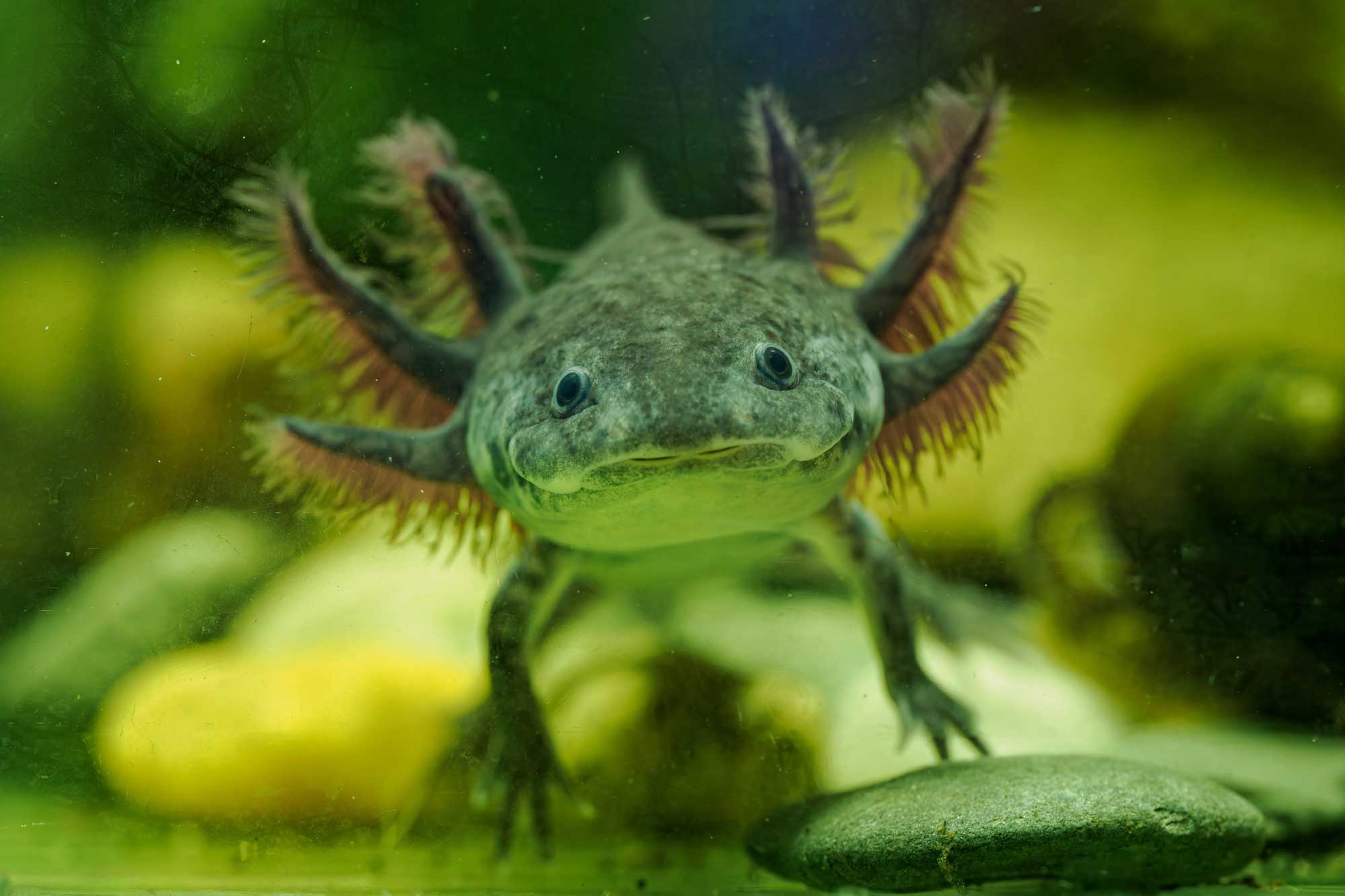
Because they never fully undergo metamorphosis, axolotls have external gills along with a body fin and tail, according to the San Diego Zoo. They also don't have moveable eyelids, and they breathe through gills underwater even though they have functional lungs.
A rare creature
Axolotls are also sometimes called Mexican salamanders, a name that hints at their native range. They are native to the Mexico City area of Mexico, where they live in lakes and other wetlands.
Today, they are found in the wild at only two lakes south of Mexico City, the San Diego Zoo reports. Much of their natural range no longer remains because many of the lakes and wetlands in this area have been drained to prevent flooding. They are listed as critically endangered on the International Union for the Conservation of Nature (IUCN) Red List.
These salamanders are also popular as pets and many live in captivity in zoos and elsewhere. Because they are so rare in the wild, much of what is known about axolotls has been gleaned from people who care for them as pets or as captive animals.
Axolotls are an important part of Mexican culture and history. They are named for the Aztec god of lightning, called Xolotl, National Geographic reports. In a popular myth, Xolotl was able to escape capture by his enemies by transforming into a water creature.
A day in the life
Axolotls have a distinctive appearance thanks to their large heads with feathery gills extending off of them, the San Diego Zoo reports. Their mouth naturally turns upward as though they are smiling. They have wide, flat bodies with short limbs like a lizard. They are usually about 9 inches long but can be as much as 1 foot long. They weigh between 2 ounces and 8 ounces, which is the weight of a stick of butter.
In the wild, most axolotls are brown or greenish-brown, but they can have a genetic condition that makes them appear pink or whitish-pink, according to National Geographic. In the pet trade, those with a pink hue are most common.
These salamanders live in still waters, and they are most active at night. During the day, they rest in the mud or amidst aquatic plants and then come out to feed at night. They are predators and have a vast and varied diet, eating insects, worms, crustaceans, mollusks, small fish and more, the San Diego Zoo reports. They don't have many predators but are sometimes hunted by large birds and fish.
A cool trick
Axolotls have a nifty adaptation that helps them survive and thrive in the wild. They can regenerate their body parts — limbs, organs and more, according to the San Diego Zoo. And there seems to be no limit to how many times they can do this. Organs can regenerate time and time again. They can even regrow parts of their brains. When an axolotl loses a limb, it regrows every part of it, from the bone to the muscle to the skin, within about five weeks without even leaving a scar.
This skill is particularly useful because axolotls will sometimes bite off the foot or gills of another axolotl that gets a little too close for comfort, National Geographic reports.
This amazing ability to regrow limbs and organs is not fully understood, but it is of keen interest to researchers, which is one reason why so many axolotls live in captivity, the Natural History Museum reports.
They have another superpower too. They are more than 1,000 times more resistant to cancer than mammals are, the zoo reports. That's another trait scientists are eager to learn more about.