Wander at Will: A wildflower hike at Raccoon Grove
Editor’s note: This story is part of our Wander at Will series, which is designed to inspire you to enjoy the many recreation opportunities in your Will County preserves in whatever ways you are able to. Whether you’re a well-traveled explorer or just starting your outdoor adventures, you’ll find new ideas, tips and hidden gems to help you connect with the outdoors all year.
The hunt for ephemeral wildflowers is one of my favorite things about spring. It really feels like a scavenger hunt as I hit the trails hoping I didn't miss my chance to see my favorites each year. Some years the weather isn't that cooperative, so I don't get out as much as I like. This spring has been wet, but warm and wet, so I've had plenty of chances to see what's in bloom.
In my six years working for the Forest Preserve District, I've learned quite a bit about our spring blooms. I know the typical bloom time for many, and I know what they look like in their various stages, from when they first emerge to when they go to seed. And while I love the search each spring for their delicate blooms, it's safe to say I'm far from an expert.
With that in mind, I decided to take advantage of the opportunity to expand my knowledge at one of the Forest Preserve's naturalist-led wildflower hikes at Raccoon Grove Nature Preserve on Sunday, April 12. The hike was led by program coordinator Suzy Lyttle, who shared the "legends and lore" of many of the flowers we encountered.

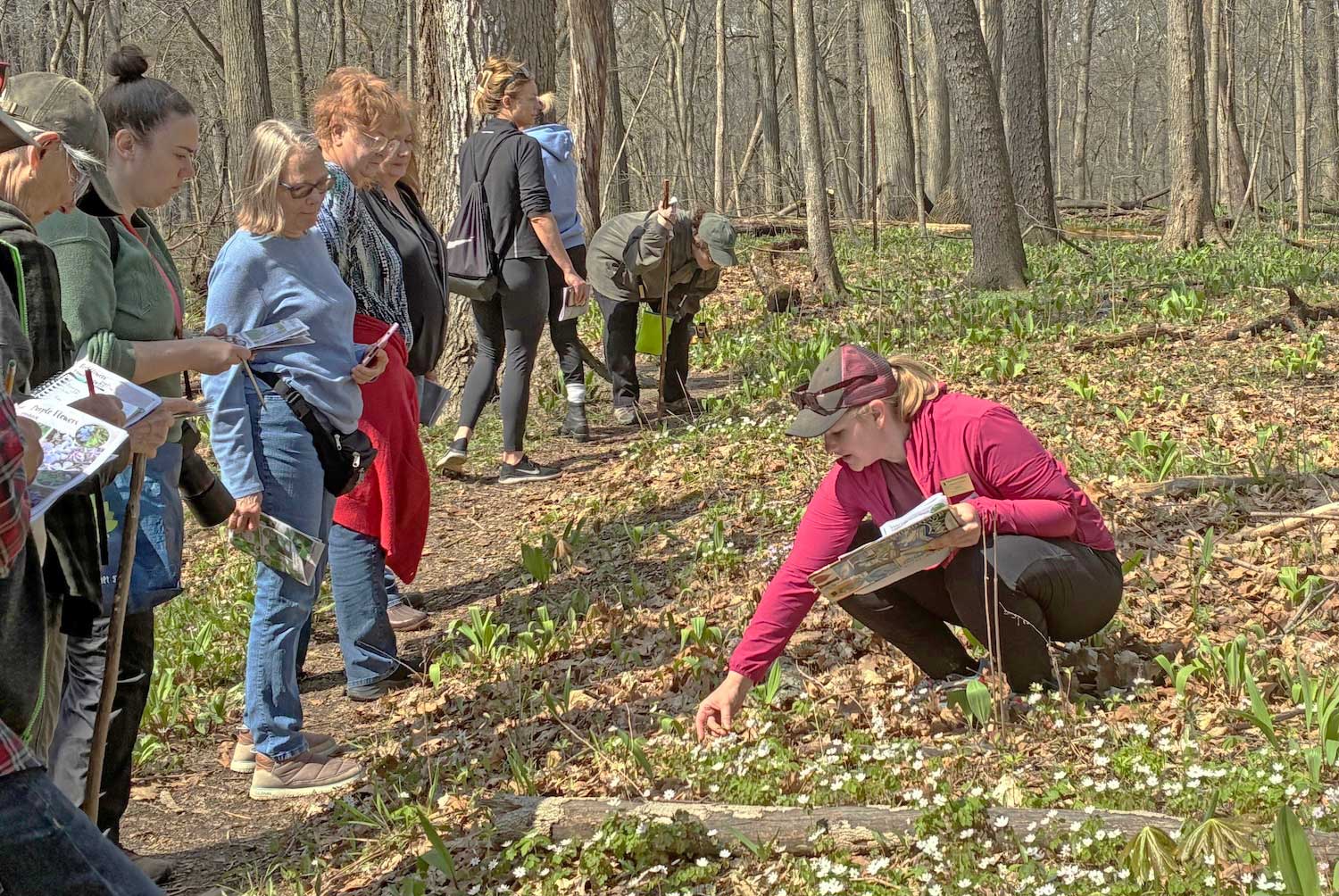
It wasn't my first time hunting for blooms at Raccoon Grove. It wasn't even my first time doing so at Raccoon Grove with Lyttle. But it was my first time tagging along on one of the Forest Preserve's spring wildflower hikes. Before we started on the hike portion of the program, Lyttle handed out wildflower guides she has created for her hikes and assigned everyone in the group of about 15 a particular flower to look for. Then we set off down the trail.
Raccoon Grove never disappoints when it comes to ephemeral wildflowers, so we didn't make it but a few steps down the trail before we stopped to see clusters of our first flower — spring beauties. Lyttle pointed out that this is one of the flowers that can be found throughout the preserve and we would be seeing it throughout our hike.
Moving on, we saw one flower after another, trout lily, mayapple, Dutchman's breeches, cut-leaved toothwort, wild leeks, yellow violets, anemones, trilliums, Virginia bluebells and more. With each stop, Lyttle explained some of the key identification features to look for and sprinkled in some fun facts as well as tidbits about how Native Americans and early settlers used the plants for medicinal purposes and more.
There was a lot of crouching and bending as everyone tried to get a close look at the blooms, some of which are quite tiny. Lyttle made sure to point out that the size can be surprising if you've only seen the flowers in photos, which can make them appear deceptively large. She included an explanation of how many of the flowers got their common names. Dutchman's breeches, for example, look like tiny Dutch pants hanging from a clothesline. And the name for anemones comes from Greek mythology, representing the tears of Venus as she wept over the body of Adonis, who had been wounded battling a boar.
In a few spots, the diversity of blooms in a small patch provided an opportunity for Lyttle to provide some key clues for telling apart similar species. We learned how to tell the difference between three anemone species — rue anemone, false rue anemone and wood anemone — and also how the placement of the flower is key in determining if the bloom you are seeing is prairie trillium or the similar-looking toadshade, also a trillium species.
Throughout, people pointed out new flowers they saw, adding even more flowers to the list of spotted species. And while all our eyes were mostly cast downward throughout, Lyttle also pointed out a few birds that were seen and heard overhead, adding to the excitement and the thrill of the hunt.
Many people jotted down notes in their wildflower guides as we walked, and plenty took photos of what we saw so they had a reference for later. By the time we returned back to the trailhead, we had seen all Lyttle had set out to show us plus much more.
For me, it was fun to have a chance to share my enthusiasm for the flowers with others, and now I know so much more about the tales of many of my favorite spring blooms.