Nature curiosity: Why do squirrels bury nuts?
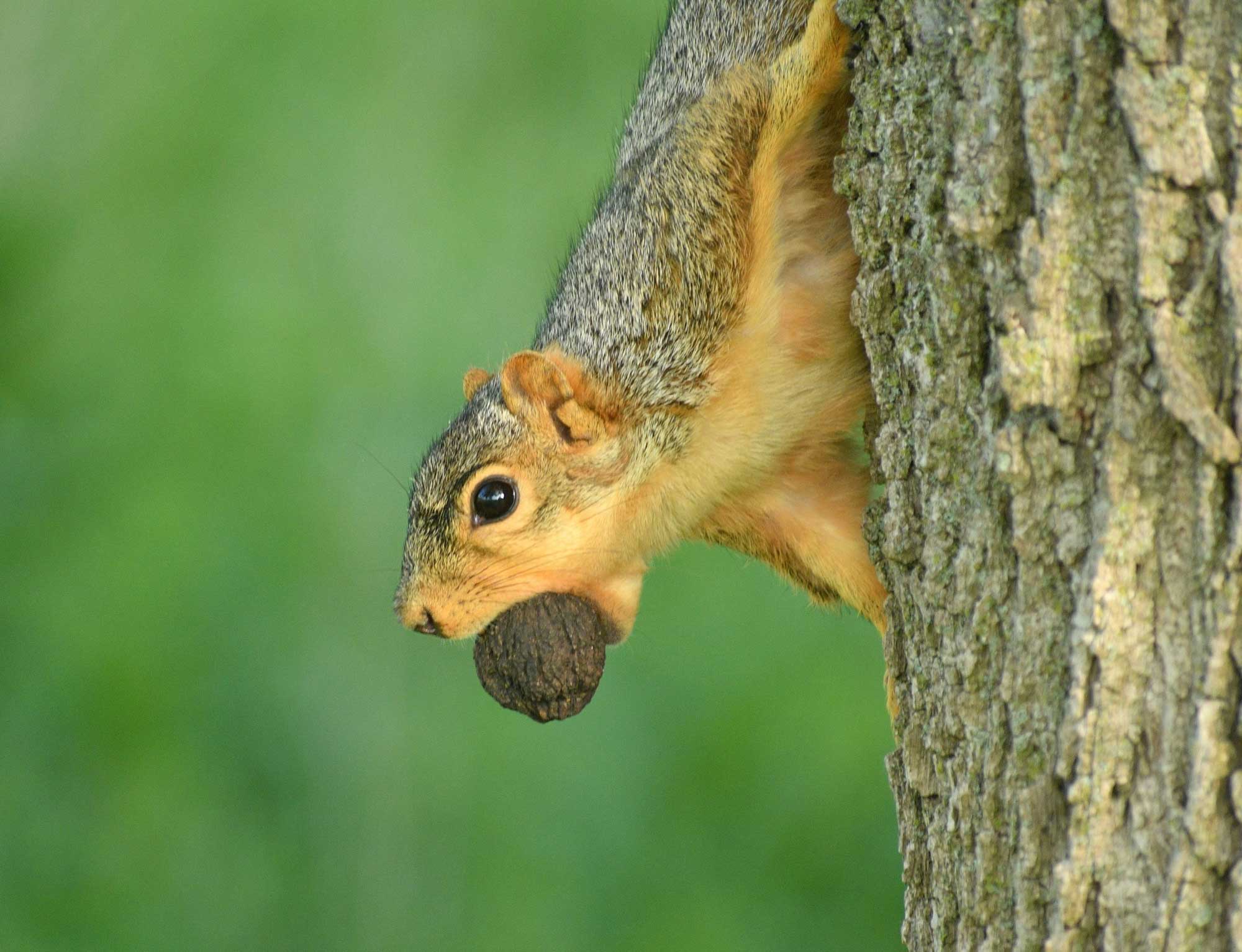
As surely as the leaves will start to change colors each fall, so, too, will squirrels start scurrying around to bury nuts here, there and everywhere.
And they can be tireless when it comes to burying nuts. A squirrel can bury as many as 3,000 nuts in a single season, Scientific American reports. For our tree squirrels, it's not just busy work, though. It's how they prepare for winter.
The reason for this flurry of activity is simple: The squirrels need to eat all winter long. They don't hibernate, so they need access to food throughout the entire year. And their preferred foods — nuts and seeds — can become scarce in winter. That means they have to stock up on it beforehand.
Hoarding behavior
To prepare for the scarcity of food in winter, tree squirrels spend their autumn collecting and caching nuts. They have two approaches to food storage: scatter hoarding and larder hoarding. With scatter hoarding, they bury nuts at many different spots, while larder hoarding will have them bury large quantities of nuts in just one or two spots.
Whether a squirrel chooses scatter hoarding or larder hoarding depends on a few factors, including the habitat; how vulnerable they are to predators; and the quality and availability of food, Scientific American reports.
Some squirrels will utilize both methods of storage to an extent, but certain species also prefer certain methods. Red squirrels more typically rely on larder hoarding while fox squirrels and gray squirrels are more likely to use scatter hoarding.
So how do scatter hoarding squirrels find the hundreds or maybe even thousands of nuts they bury? Oftentimes they don't. While they are able to return to many of their buried nuts for a winter meal, it turns out many are left behind. In fact, as many as 74% of buried nuts are never recovered, according to the Smithsonian Science Education Center.
Their loss is the forest's gain. One of the key roles squirrels play in the ecosystem is that their forgotten nuts and seeds aid in forest regeneration because some of those forgotten foods grow into trees. (Their other key role is their part in the food web. They are preyed on by many different kinds of predators, birds and mammals alike, according to Wildlife Illinois.)
Nature's thieves
When it comes to food reserves, squirrels aren't the most honest animals out there. They are known to steal from other squirrels' caches, digging up their nuts for themselves. It's not all that rare, either. As much as 25% of a squirrel's cache can be lost to thievery.
Stealing nuts is so common that squirrels have developed a few strategies to prevent it. First, they sometimes will dig holes but never deposit a nut inside, the Smithsonian center reports. They also will look for out-of-the-way or hard-to-access spots, like under bushes or muddy spots, if they know their nuts are being stolen. Squirrels will also sometimes bury and then rebury the same nut in different places, which may also help them remember where they have stored them.