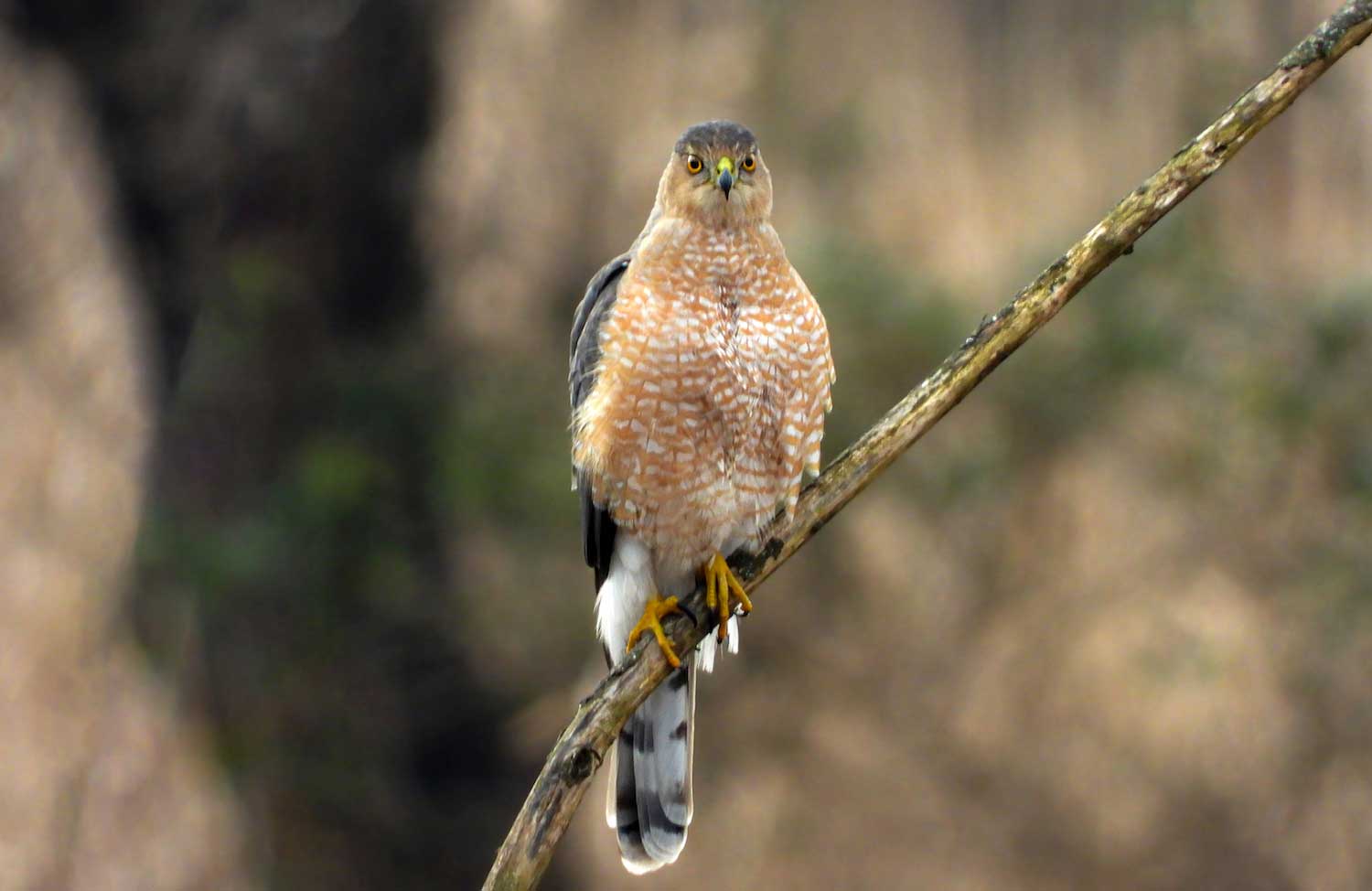
Cooper's hawks are agile and adept hunters
An actual hawk might not be the first thing that comes to mind when you hear Cooper's hawk, but it was the name of a bird long before it was a popular winery and restaurant chain.
Cooper's hawks are a common raptor species that can be found across much of the United States as well as Mexico and southern Canada. They are migratory, but they can be found in Illinois all year long. They are considered a forest bird and prefer deciduous forests, but it's not unusual to see them in parks and yards and neighborhoods, according to the Cornell Lab of Ornithology.
While many hawks are named for an element of their physical appearance, the Cooper's hawk is named for a person. Naturalist and ornithologist Charles Lucien Bonaparte, a nephew of Napoleon Bonaparte and the namesake of the Bonaparte's gull and a few other bird species, named the bird for friend and fellow ornithologist William Cooper. Cooper was the scientist who collected the specimens of the birds that were used to initially describe the species, according to the Chattahoochee Nature Center.
Who's who?
These hawks belong to the accipiter family of hawks, which are forest-dwelling hawks with short wings and long tails that help them fly through the trees, according to the National Audubon Society. Other accipiters in North America are the sharp-shinned hawk and the American goshawk. Of these two, the sharp-shinned hawk is strikingly similar in appearance to the Cooper's hawk, and the two birds are often confused for one another. The two also have similar behaviors and habitats, adding to the confusion.
Both birds are steely gray or grayish blue on their backs and wings with white and rusty red barred plumage on their underparts. Cooper's hawks are the larger of the two. They are similar in size to a crow, while sharp-shinned hawks are more similar in size to a blue jay.
A few other physical differences between the two include their head shape and tail feathers. Cooper's hawks have blocky, dome-shaped heads, while sharp-shinned hawks have smaller, rounded heads. The tail feathers of the Cooper's hawk are also more rounded, while the sharp-shinned hawk has a straight edge to its tail feathers.
A bird that eats birds
Don't be surprised to see a Cooper's hawk hanging around your backyard bird feeders. It's not the bird seed they are after, however. Instead, they are on the hunt for the birds visiting your feeders. Like other birds of prey, Cooper's hawks hunt small animals, and their prey of choice is primarily birds, especially medium-sized birds like mourning doves, European starlings, robins and jays, the Cornell Lab reports. They'll even sometimes go after larger birds like pheasants and quail and even chickens. In addition to birds, they will also hunt small mammals, although this is more common in the western part of their range.
They typically hunt while perched above, scanning all around for prey. Once they spot a meal, they will wait for it to look away and then swoop down for the catch, the Chattahoochee Nature Center reports. Thanks to their excellent maneuverability, they can give chase if necessary, navigating with ease through tree canopies.
Cooper's hawks are mostly quiet birds. They don't sing like songbirds do, but males and females will communicate with one another during breeding season. Males will call out with a loud cak-cak-cak sound while attracting a mate, and both males and females will make a similar sound when they have to defend their nests, the Cornell Lab reports. Females are less vocal than males, but they do call out as they approach the males.
Like many other raptors, Cooper's hawks typically mate for life, according to Animal Diversity Web. In Illinois, breeding season is from April through June.
They nest in trees, typically building their nests about two-thirds of the way up the tree. The males are the main nest builders, with the female occasionally helping by supplying nesting material. Sticks are used to build the structure, then it is lined with bark and twigs, a process that takes about two weeks, according to the Cornell Lab.
Females lay one brood of eggs a year, containing anywhere from three to six eggs, but normally four or five. The female is the primary incubator, and the eggs typically hatch after about five weeks. Both parents will provide food for and look after the young hawks. They will have grown enough to leave the nest after about a month, but the parents will continue to feed them until they are about 2 months old.
Back from the brink
The population of Cooper's hawks has been rising in recent decades, and they are a species of low conservation concern, the Cornell Lab reports. However, their population was at one time declining sharply for the same reason that the populations of bald eagles, peregrine falcons and other birds were under threat. In the middle 20th century, these birds were at risk because of the use of the pesticide known as DDT.
DDT was used to control insects, and when Cooper's hawks and other birds ate insects that had been contaminated by it, the chemical began to accumulate in their bodies. Over time, this affected the birds' ability to nest because it caused their eggs to have thin, weak shells that did not allow chicks to properly incubate and hatch. The use of DDT was banned in the United States in 1972, and the populations of the birds impacted by it have since recovered, albeit to different degrees.
Now that their population has stabilized, Cooper's hawks play a key role in the ecosystem by helping control the population of some of the birds and mammals they hunt. Main threats to their population today include habitat loss and habitat degradation, although collisions with windows and other objects also pose risks to the birds, particularly in more urban areas. Cooper's hawks are protected by federal law in the United States, making it illegal to hunt, kill or possess them.