Family-owned woodland acquired for new Horse Creek Preserve
On Sept. 9, the Forest Preserve purchased 126 acres of land in Custer Township that will be known as Horse Creek Preserve – Kang Woodland.
“It’s exciting to create a new preserve after almost 100 years and 24,000 acres under our belt,” said Forest Preserve Executive Director Tracy Chapman. “Horse Creek is the defining natural feature of the property. It serves as an important waterway and habitat corridor, making the decision to name the site Horse Creek Preserve a pretty easy one.”
This land has a special history. It was first purchased and preserved by a Chicago couple who dedicated decades to protecting the property, beginning in the 1980s.
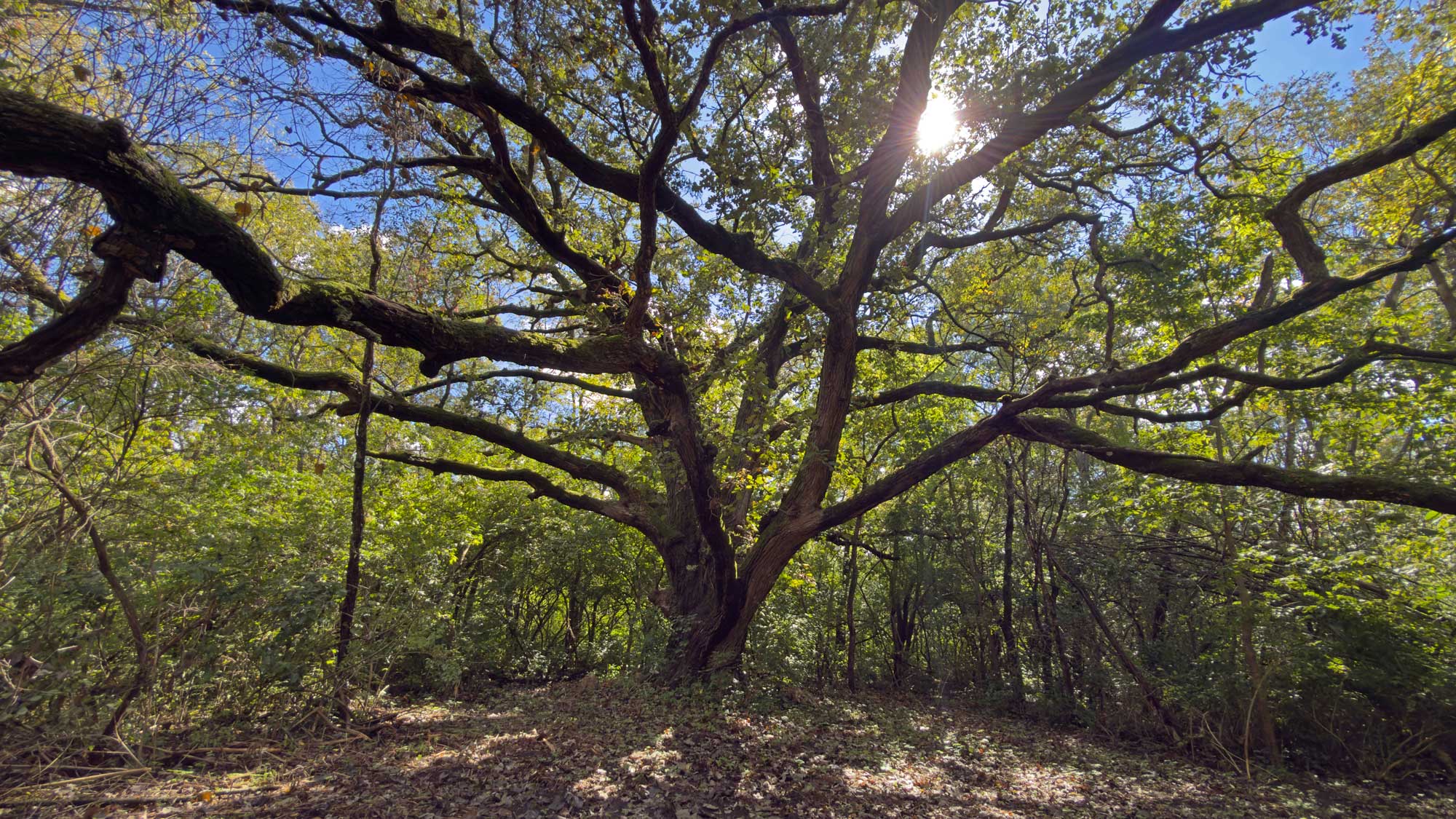
Dr. Shin Theke Kang and his wife, Tae Sue Kang, reforested some of the agricultural portions of the property to complement the legacy trees, including one bur oak thought to be hundreds of years old, that had been growing along Horse Creek. Shin Kang, who grew up on a farm in Korea, planted hundreds of trees by hand and hired a company to plant thousands more. Many trees survived even without irrigation.
The parcel is now home to more than 32,000 black walnut, oak, maple, ash, pine and cherry trees. The family has documented a robust list of wildlife, including the yellow-billed cuckoo, slender glass lizard, white-tailed deer, bald eagle, wild turkey, ring-necked pheasant, red fox, native songbirds such as warblers, thrushes and vireos, and pollinators in the woodland edge and riparian (water's edge) zones.
High-quality habitat
The purchase is part of the Forest Preserve's $50 million 2025-2030 Capital Improvement Program, which has dedicated funds to acquisition, restoration and preserve improvements. So far, 1,019 acres have been purchased, including the Horse Creek land, bringing the total acreage the District owns, manages and leases to 24,228.
“Horse Creek is a beautiful stream with high-quality aquatic habitat that flows into the Kankakee River,” said Juli Mason, director of conservation programs for the District. “There are numerous records of rare fish, mussels, and other aquatic wildlife in the vicinity.”
The property protects important natural resources, especially the area along the creek, and it has tremendous restoration potential, she added.
“By conserving this section of Horse Creek and its surrounding corridor, we are helping protect water quality, aquatic habitat and the wildlife that depends on the connection between Horse Creek and the Kankakee River,” she said.
The parcel’s proximity to the southern terminus of the Wauponsee Glacial Trail also made it an enticing purchase, said Colleen Novander, the Forest Preserve District’s director of planning and land preservation.
“Our first acquisition in the Horse Creek watershed provides an exciting opportunity to expand recreational opportunities in southern Will County,” she said. “The property has the potential to support an internal trail system and associated amenities while also providing an opportunity to extend the Wauponsee Glacial Trail south of Route 113. Ultimately, we envision this property serving as an important southern access point and connection to the broader trail network.”
‘In my heart’
The Kangs, who reforested a portion of the land, now live in California. Their daughter, Meea Kang, responded to questions via email about the history of the land. She said she talked to her dad recently about what motivated him to reforest the property.
“At 90 years old, his answer was much simpler and more personal than I expected,” she said. “He said, ‘Because land and trees go together.’ He told me that whenever he owned land, he planted trees. When I asked him why, he said, ‘I planted the trees because that was my heart.’”
Her dad devoted his professional career to the study of ancient civilizations and languages, and he served as curator of the World Heritage Museum at the University of Illinois in Urbana-Champaign.
“He taught Sumerian, Babylonian and the ancient near Eastern history and worked directly with ancient cuneiform tablets – clay documents written thousands of years ago in Mesopotamia,” Meea said.
Her mother, Tae Sue, who was the steady support behind her father, founded a Korean American Senior Center in Chicago, which continues today as the Hanul Family Alliance. She also served as president of the Coalition of Limited English Speaking Elderly.
“She devoted much of her life to advocating for older immigrants who faced language and cultural barriers in accessing health care, social services and community support,” Meea said.
Dedication to stewardship
Meea said her parents’ careers looked different, but they complemented each other.
“My father recovering and translating voices from thousands of years ago, and my mother helping immigrant elders have a voice in their own time. But both were acts of stewardship across generations.”
That same dedication to stewardship led them to plant the trees at Horse Creek.
“The extraordinary part is what happened afterward,” Meea said. “There was no irrigation infrastructure supporting the plantation. The trees had to establish themselves under the natural hydrologic conditions of the Horse Creek floodplain.”
As the Kangs aged and relocated, they decided the Horse Creek land should be sold. The fate of the property was important to the family.
“Because after nearly half a century, we realized we were no longer deciding simply what should happen to a piece of family real estate,” Meea said. “We were deciding what should happen to an ecosystem and to a piece of our parents’ life’s work.”
Knowing the land is now a forest preserve feels like the proper outcome, she said.
“My father spent his career preserving the meaning of the past. My mother spent hers strengthening community in the present. Together, they created and cared for a landscape that can now be protected for the future.”
Meea said she keeps going back to her dad saying he had the trees planted on the land because of what was in his heart.
“What began in his heart became a forest,” she said. “Now, as Kang Woodland, that forest can become a permanent public legacy.”