Who cooks for you? Barred owls' unique call hard not to recognize
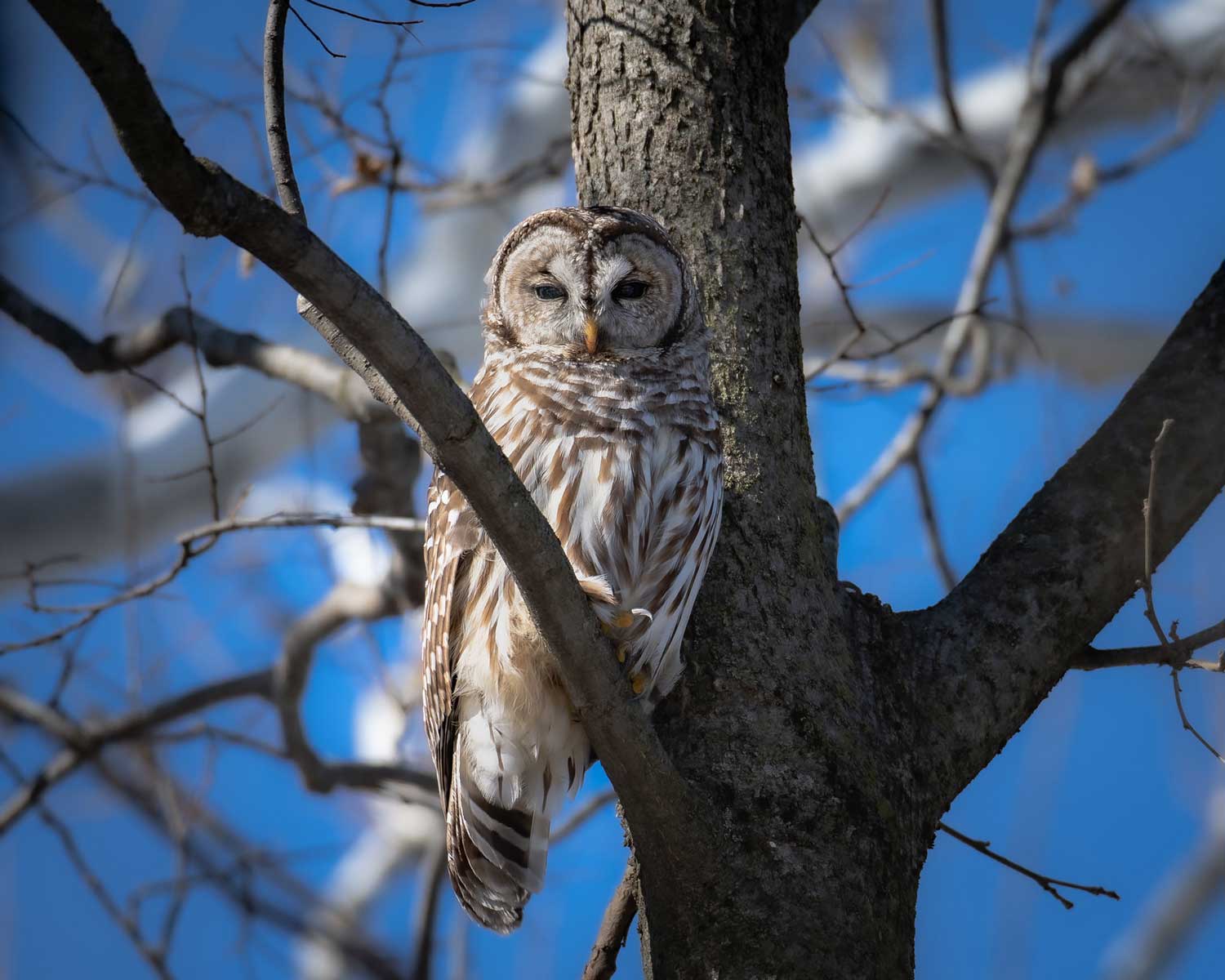
There's only one bird that's likely to be calling out in the woods about who's cooking dinner, and it's the barred owl.
These distinctive-looking owls are better known for their hard-to-miss call, which sounds like they are calling out across the forest: "Who cooks for you? Who cooks for you all?" Don't believe it? Take a listen:
From a distance, their call might sound like a dog barking, but as you get closer it becomes more distinctive. Barred owls often call out with the familiar song in a sequence of eight, and if you're lucky you may hear a pair — a male and a female — calling back and forth to one another, according to the American Bird Conservancy.
So unique is the sound of a barred owl's call that historians believe Harriet Tubman used it as a signal for people traveling along the Underground Railroad, according to the National Audubon Society. In addition to her work as an abolitionist and her duties as a scout, spy and nurse for the Union Army during the Civil War, Tubman was an avid naturalist and used her familiarity with bird calls to communicate with those traveling along the Underground Railroad.
If you can catch a glimpse of one, you'll recognize barred owls from their rounded heads, mottled brown and white plumage and yellow bills, according to the Cornell Lab of Ornithology. Their heads are rounded because they don't have ear tufts like great horned owls, long-eared owls, eastern screech owls and some other species. Barred owls also have dark eyes, which is not common among owls.
Barred owls are large owls, generally standing between 18 inches and 20 inches tall and weighing between 1.2 and 1.7 pounds, according to the Owl Research Institute. Compare that to great horned owls, among the largest of our local owl species. They are generally between 20 inches and 23 inches tall and can weigh between 2.9 pounds and 3.3 pounds. Female barred owls and great horned owls are larger than the males, which is common among raptors.
Historically, barred owls have lived across much of the eastern United States and southeastern Canada. More recently, they have begun to expand their range into the Pacific Northwest. They don't migrate and usually stay very close to their home territory. Look and listen for them in mature woodlands. It is believed that they prefer old forests because the food supply is more diverse and there are more available nesting cavities in old tree trunks, the Cornell Lab of Ornithology reports.
Like all raptors, barred owls are carnivores, and they hunt for a variety of animals, including small mammals, birds, amphibians, raptors and invertebrates. They usually hunt just after sunset and into the night, but they sometimes hunt by day as well, according to the Cornell Lab. To find prey, barred owls will usually perch themselves up high and scan all around, looking and listening for prey down below.
Barred owls often eat their prey whole, swallowing it down headfirst. If it is too big to swallow whole, they will tear it into large pieces. When they hunt more than they can eat, they sometimes store food in their nest, in a tree snag or in the crook of a tree branch, the Cornell Lab reports.
Because barred owls and other owl species swallow prey whole or in large chunks, they eat a lot of pieces they can't digest. Those bits — bones, teeth, fur and feathers — aren't able to be liquefied with the fleshy part of the meal, so they are compressed into a pellet, according to the Cornell Lab. These pellets are then cast out, usually one per day. If you find owl pellets on the ground, an owl roosting spot is probably right above because they usually throw up their pellets from these spots.
While barred owls are highly skilled hunters, they are sometimes hunted as well. Their main predator is the great horned owl, which will eat eggs from their nest and also hunt the young owls and even sometimes the adults, the Cornell Lab reports. Barred owls and great horned owls will sometimes occupy the same areas, but barred owls will often move to another part of their territory when a great horned owl gets too close for comfort.
We tend to think of spring and summer as breeding and nesting season for birds, but many raptors, including barred owls, begin the process in winter. Courtship will begin in February, with breeding starting as early as March, the American Bird Conservancy reports. They typically nest in tree cavities, although they sometimes will move into large, abandoned nests from crows, hawks and squirrels. They even sometimes use nesting boxes in forests.
The female will lay between one and five eggs, but two or three is most common. The female alone incubates them for about a month before they hatch. Both parents will care for the owlets, usually for at least four months, which is longer than most owls, according to the conservancy. The owlets will begin to leave the nest and explore the branches around it about a month after they hatch. This process is called branching, and other raptors practice it as well. The owlets won't learn to fly until about 10 weeks after hatching. The brood will remain together throughout the summer and then leave to establish their own territory in the fall.
The barred owl population across North America has been increasing since the mid-20th century, with growth estimated at 1.1% per year from 1966 to 2019, according to the Cornell Lab. They are considered a species of low conservation concern. However, because they live in mature forests and need large trees for nesting, they are sensitive to increased logging activities.