
Wild Relatives: The paradise tree snake can fly
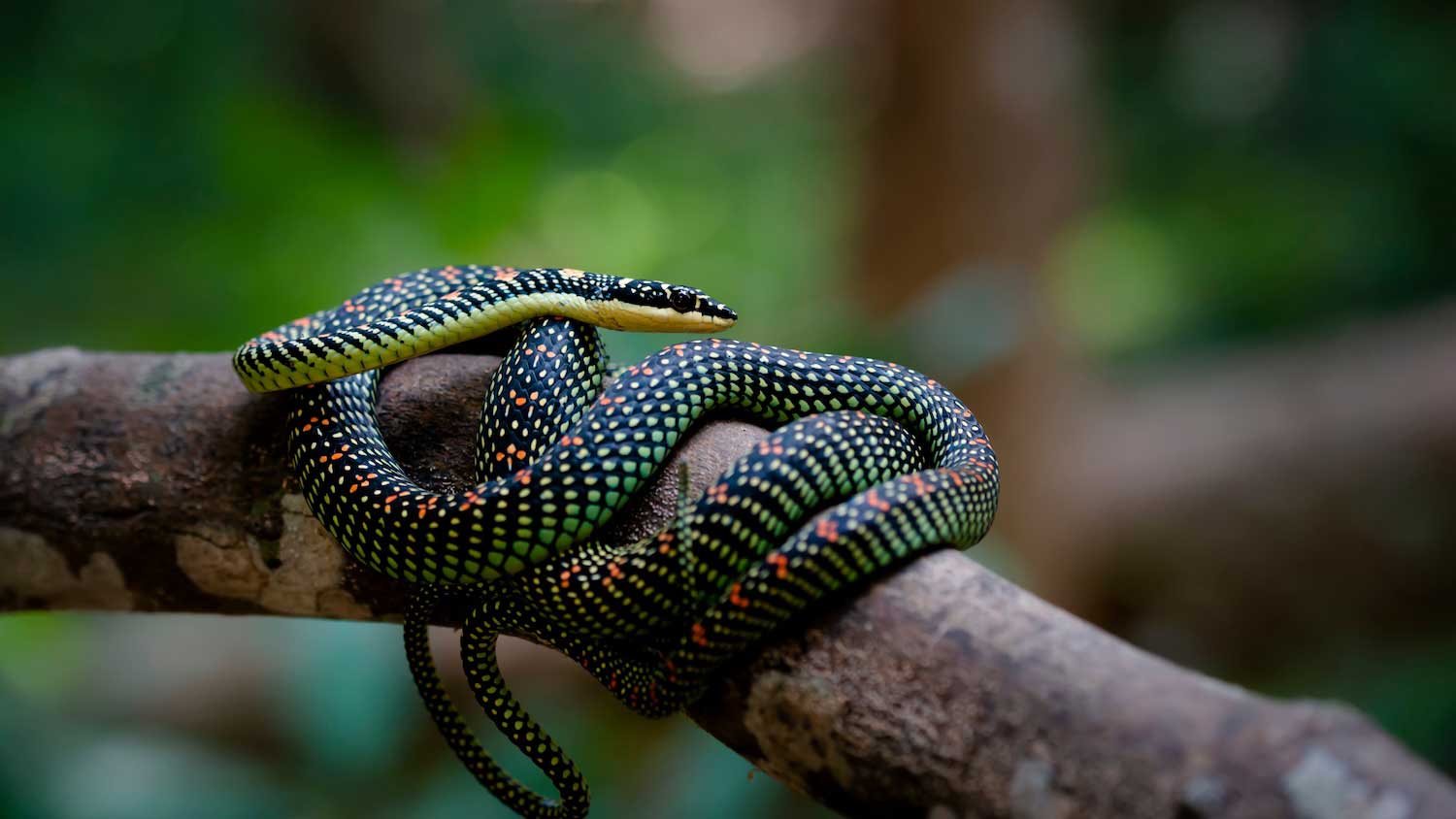
Editor’s note: Our Wild Relatives story series will explore the connections between our local wildlife species and related animals from around the globe. By learning about these exotic species, we hope to foster appreciation for the remarkable creatures that live in our backyards and neighborhoods.
If the movie "Snakes on a Plane" was enough to keep you up at night, it may be alarming to learn there are snakes in the world that are capable of flying on their own, moving from tree to tree in the forest without ever touching the ground.
But just like flying squirrels aren't really flying like birds do, neither are the so-called flying snakes. Instead, the snakes glide through the air rather than fly, just like flying squirrels do.
Flying snakes belong to the Chrysopelea genus of snakes. The most well-known of these snakes is the paradise tree snake, which is also known as the paradise flying snake or garden flying snake. Other flying snake species include the ornate flying snake, Moluccan flying snake and Indian flying snake.
Getting airborne
Flying snakes can move from side to side in the air, which helps them turn in flight. This capability makes them more accomplished in flight than flying squirrels, according to National Geographic. Their method for becoming airborne is quite intricate. First, they have to make their way to the end of a branch then dangle their body down into a J shape. From there, they use the lower part of their body to propel themselves from the branch, quickly transitioning to an S shape and then flattening their bodies so they form a concave C shape allowing them to trap air, which sends them airborne.
SEE MORE STORIES IN THE WILD RELATIVES SERIES
How often these snakes take to the air rather than slithering is not known, but scientists believe their gliding ability helps them escape danger and more efficiently move through their habitat, National Geographic reports. They can also hunt more easily because they can go airborne to cover more ground.
At home in Asia
If the idea of snakes flying through the air weighs on your mind, we have good news. You'd have to travel pretty far from home to encounter a flying snake in its natural habitat. The paradise tree snake and other flying tree snakes are native to South Asia and Southeast Asia, NPR reports. They can be found in countries including Cambodia, China, India, Indonesia, Malaysia, the Philippines, Singapore, Thailand and Vietnam.
Most flying snakes are found in forested areas, but some species will also inhabit more open areas like plantations or secondary forests, according to the BBC.
Paradise tree snakes are slender snakes, and they can grow to be about 3 feet to 4 feet long. From above, they are mostly black with yellowish-green or yellowish-green and red spots. Their bellies are yellowish-green.
Like all snakes, the flying snakes are carnivores, but their diet can vary depending on where they live and what is commonly available. Known food sources include bats, birds, rodents, lizards and frogs, National Geographic reports.
Venomous — but not dangerous to humans
The paradise tree snake is among the 10% of snake species in the world that are venomous. However, they are only mildly venomous, and they are not dangerous to humans, National Geographic reports.
Snakes have different means of reproduction, with some laying eggs and some giving birth to live young. Paradise tree snakes are oviparous, which means they lay eggs.
Not much is known about their reproductive cycle, but most females will lay clutches of between five and eight eggs, the BBC reports. When the snakes hatch, they are fully independent and able to live and hunt on their own. This is common among snakes.
Most of the snakes from the Chrysopelea genus have stable populations across their range, and some, like the paradise tree snake, are considered common in some places. However one species, the Indian flying snake, is thought to be on the decline, according to the International Union for the Conservation of Nature (IUCN) Red List.