
Wild Relatives: The pyrrhuloxia
Editor’s note: Our Wild Relatives story series will explore the connections between our local wildlife species and related animals from around the globe. By learning about these exotic species, we hope to foster appreciation for the remarkable creatures that live in our backyards and neighborhoods.
Cardinals are one of the most recognizable birds around, but in some parts of the United States and beyond, there's a bird that looks just like a cardinal but with colors that just don't seem to match our familiar bird.
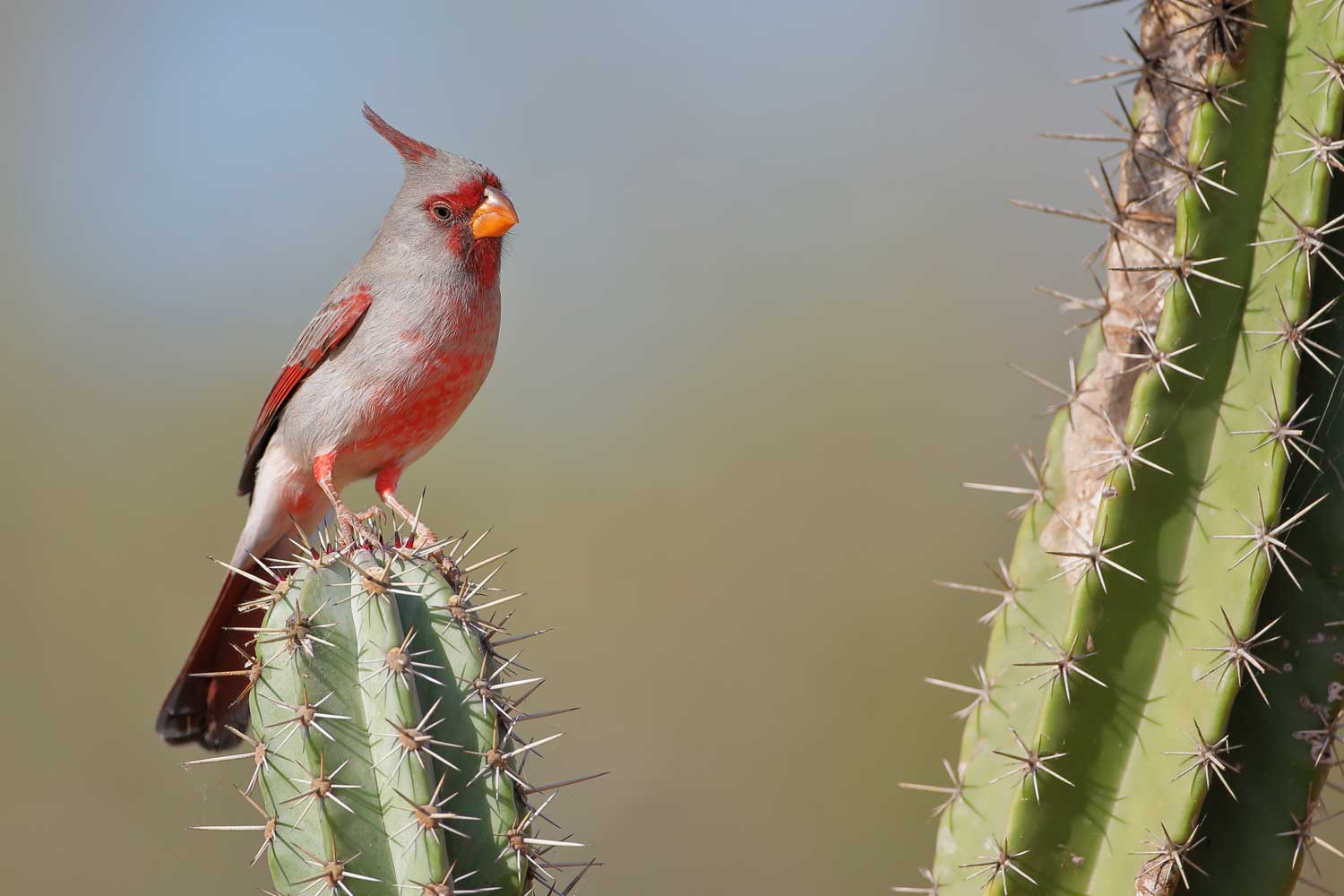
The pyrrhuloxia looks an awful lot like the northern cardinal, just in a different color way. But before learning more about this bird, you might be wondering how to pronounce its name. Pyrrhuloxia is a five-syllable word: peer-uh-lock-see-uh. Now that you can pronounce its name, you can learn all about it.
Cardinal lookalikes
Pyrrhuloxias are closely related to northern cardinals, and the resemblance is quite striking. Both birds are stocky with prominent crests on their heads and heavy bills. If you saw silhouettes of the two birds side by side, you might not be able to tell the difference. Their coloring is very telling, though.
Whereas male northern cardinals are nearly entirely red with some black highlights, male pyrrhuloxias are a rich gray color with red highlights. And the females of both species are not nearly as bright and showy as the males. Female pyrrhuloxias are also gray, but a lighter shade than the males. And they have a few red highlights too, but not as bright and showy as the males, according to the Cornell Lab or Ornithology.
Desert birds
Pyrrhuloxias are sometimes referred to as "desert cardinals" because while their appearances are similar, their habitats are not. These birds prefer arid, dry conditions and are most often found in upland deserts and scrublands as well as mesquite savannas. They are also sometimes seen in woodlands near rivers and streams and in agricultural fields, the American Bird Conservancy reports.
Where you might see the pyrrhuloxia is quite limited compared to the northern cardinal. While cardinals can be found across the entire eastern United States as well as parts of the American Southwest and much of Mexico, the pyrrhuloxia has a small range. They are only found in parts of Arizona, New Mexico and Texas as well as much of northern Mexico, the Cornell Lab reports.
The southwestern portion of the cardinal's range overlaps with the pyrrhuloxia's, so there are parts of the desert southwest and Mexico where you might spot both of these birds.
In the dry desert areas where they live, pyrrhuloxias spend their time foraging for a variety of foods, including seeds, fruits and insects. They are opportunistic eaters and will feast on what is readily available to them, primarily seeds and insects, according to the Cornell Lab. Fruit is a smaller part of their diet compared to cardinals.
Sweet-singing songbirds
Just like both male and female cardinals sing, which is unusual in the bird world, so, too, do male and female pyrrhuloxias, the American Bird Conservancy reports. And their songs are quite similar as well, with both sounding like repeated notes of "chip, chip, chip, chip" or "cheer, cheer, cheer, cheer."
Female pyrrhuloxias aren't frequent singers, usually limiting their songs to when they are defending their nests. Males have a variety of songs that they most often use to establish their territory or attract a mate.
These birds prefer more open areas for nesting than cardinals do, typically choosing a nesting spot about 5 feet to 15 feet above the ground in dense brush. The female does most of the nest construction, weaving together materials such as twigs, grass and bark, according to the Cornell Lab.
Females can lay one or two broods of eggs a year, with each containing between two to four eggs. The eggs are incubated for about two weeks, and the nestlings will remain in the nest 10 to 14 days before fledging.
Pyrrhuloxias are still considered widespread and common, but their population has been on the decline. In the past 50 years, their population has dropped by 50%, and declines have been increasing for the past 10 years, the American Bird Conservancy reports.
Many factors are contributing to the population decline. The desert scrubland habitat where they primarily live is decreasing as land is repurposed for agriculture and development, and they also face threats from climate change and invasive species.