
Skippers are tiny butterflies with big speed
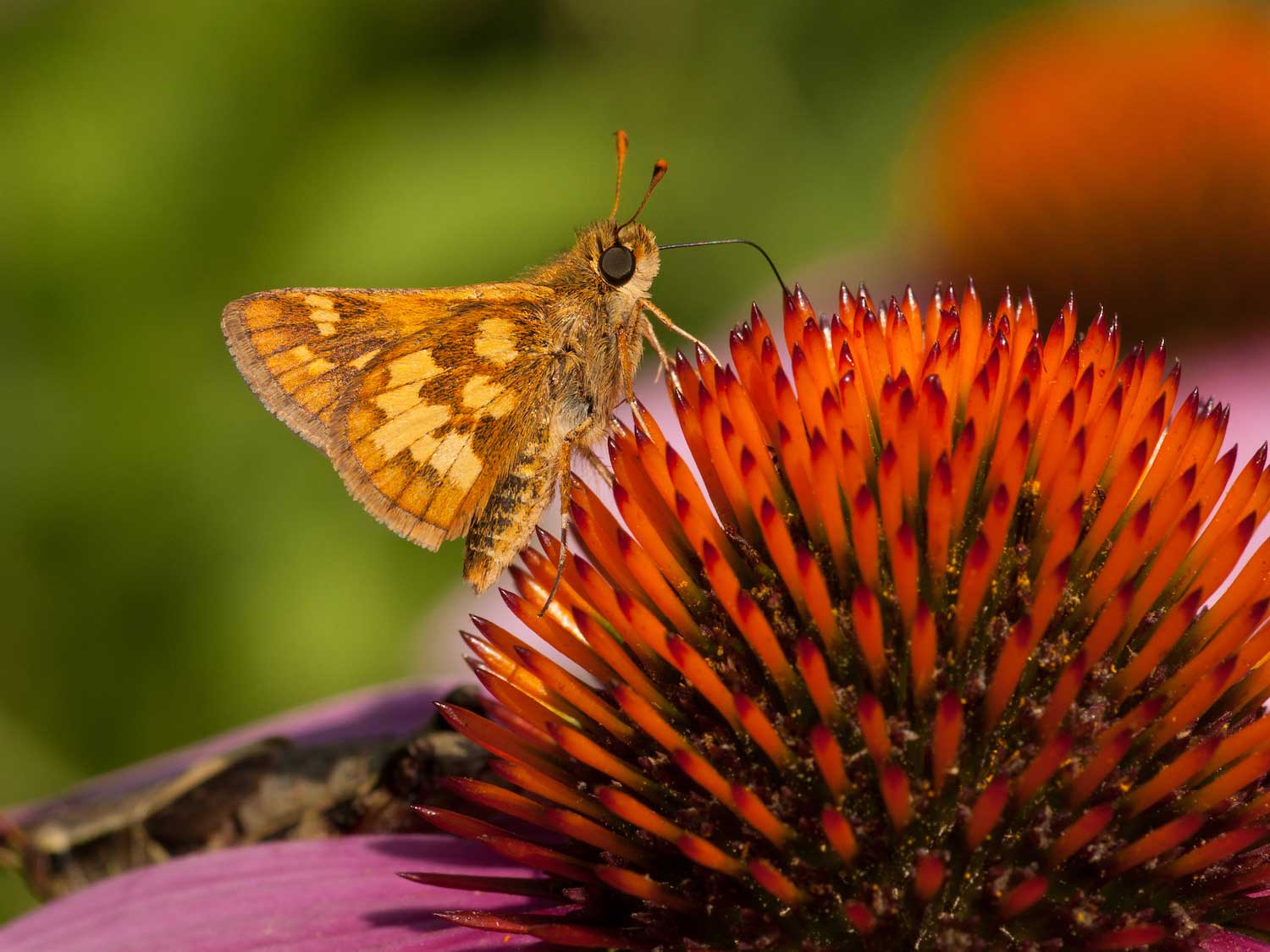
What's faster and smaller than a butterfly but still somehow a butterfly? A skipper!
Like moths and butterflies, skippers belong to the insect order Lepidoptera. Although they were at one time thought to be their own distinct group within the order, skippers are now classified as butterflies, according to Birds & Blooms. So skippers are a type of butterfly, and they belong to their own family, Hesperiidae, within the order Lepidoptera.
One key identification feature to distinguish between skippers and butterflies is their antennae, specifically the tips of their antennae. Like butterflies, skippers have club-tipped antennae, but nearly all skippers have antennae that have a hook-shaped bend at the tip, according to the Missouri Department of Conservation.
There are a few other generalities about skippers that help distinguish them from butterflies and moths. For starters, they are small, much smaller than the butterflies we are familiar with. Their wingspans are usually no more than 1 1/4 inches, although some can be a bit larger, the Missouri Department of Conservation reports. Compare that to the monarch, which has a wingspan of 3 inches to 4 inches.
Skippers also tend to have short, stocky bodies, more like moths than butterflies. And they often have more drab color patterns, with shades of orange, brown, tan, gray and white common in the Hesperiidae family.
Compared to moths and butterflies, skippers are fast flyers, according to the San Diego Zoo. They can reach speed of up to 37 mph while flying. That's pretty speedy when you consider that butterflies usually fly at speeds between 5 mph and 12 mph. Skippers are actually called skippers because of their fast, darting flight pattern, which makes it look like they are skipping through the air.
Like butterflies, skippers fly by day, visiting flowers for nectar, the Missouri Department of Conservation reports. They also engage in "puddling," which is when they visit mud puddles or even animal waste to collect minerals. Some butterflies and moths also puddle to get the nutrients they need.
All told, there are about 3,500 described skipper species in the world, with about 275 in North America, according to Butterflies and Moths of North America. Common skipper species in Illinois include the European skipper, fiery skipper, least skipper and Peck's skipper. European skippers are not native to our region but have been present since the early 1900s.
Our local skipper species all can be found in open areas like prairies and fields, according to the Illinois Department of Natural Resources. Most can be seen from about April through October. In the case of the fiery skipper, however, summer is the season we see them locally because they are migratory.
Skippers are generally divided into two groups: folded-wing skippers and spread-winged skippers, according to the Peggy Notebaert Nature Museum. The distinction between the two is in how they hold their wings: Folded-wing skippers hold their wings closed or in a V formation when at rest, while spread-wing skippers hold their wings open.