
From pavement to prairie: 20 years of restoration work honored
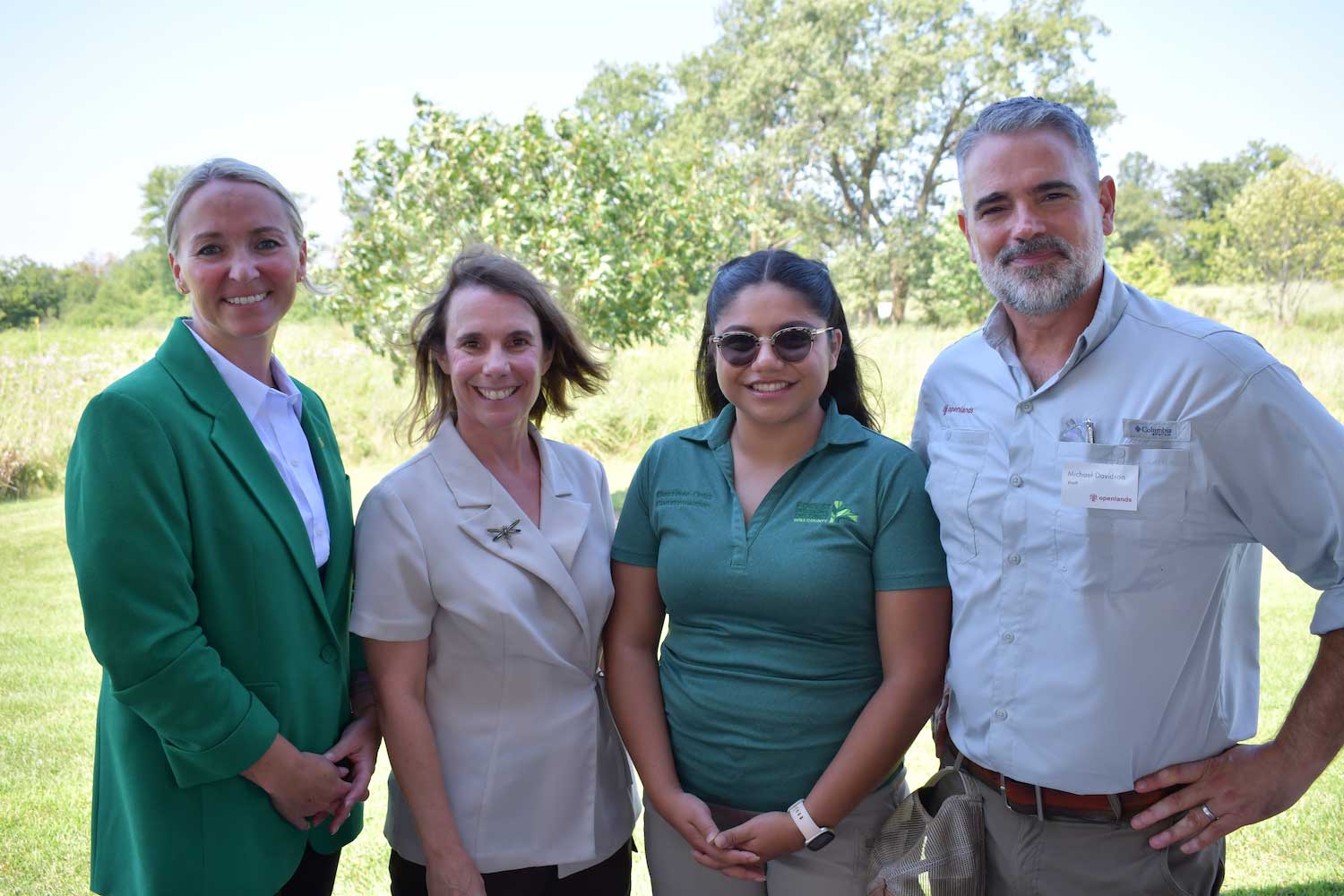
From left: Forest Preserve Executive Director Tracy Chapman, Forest Preserve Director of Conservation Juli Mason, Forest Preserve Board President Destinee Ortiz and Openlands President and CEO Michael Davidson. (Photo by Glenn P. Knoblock)
Officials from the Forest Preserve District of Will County and Openlands gathered Friday, Aug. 8, to celebrate two decades of wetland and habitat restoration funded by money set aside for the loss of wetlands caused by O'Hare Airport expansion.
Forest Preserve Board President Destinee Ortiz welcomed guests at Hadley Valley – Gougar Road Access to mark the milestone and tour the site.
The O’Hare Modernization Mitigation Account, created in 2005 to offset the loss of 280 acres of wetlands from an $8 billion airport expansion, was funded with $26 million from the City of Chicago. The Forest Preserve District received $6 million from the account for restoration work at Hadley Valley and Messenger Woods Nature Preserve in Homer Glen.
Over two decades, OMMA funds overseen by Openlands have restored 530 acres of wetlands – almost double what was lost at O'Hare – and 1,620 acres of protected natural space at Hadley Valley, Messenger Woods, two Cook County preserves and Midewin National Tallgrass Prairie. The restoration work and maintenance officially concluded in January.
"This isn’t just a celebration of land, it’s a celebration of what’s possible when we come together with a shared purpose,” said Destinee Ortiz, the Forest Preserve's Board president. “Today we celebrate 20 years of partnership, perseverance and passion that has truly brought this landscape back to life."
The event also highlighted the Forest Preserve’s next chapter.
"Thanks to the $50 million bond approved by our Board in 2024, we’re just getting started,” said Tracy Chapman, the Forest Preserve’s executive director. “This investment will preserve more land, restore more habitat and connect more people to nature across Will County.”
At Hadley Valley, the largest restoration in Forest Preserve history, 193 acres were restored, including 60 acres of wetlands.
"Hadley Valley is a living, breathing example of what long-term restoration rooted in collaboration can achieve,” Chapman said. “For 20 years, Openlands has led this remarkable restoration effort, and we are proud to be co-hosting today’s celebration with them."
The five OMMA-funded sites are “gold standard landscapes,” said Michael Davidson, president and CEO of Openlands.
“This project shows what’s possible when you pair significant investment with long-term stewardship," he added. " ... I think this project, Hadley Valley and the other four sites, represent a rare model of large-scale, high quality restoration in a metro region."
Davidson said the restored areas are beautiful and good for wildlife, our health and the environment. They also improve water quality, reduce flooding and recharge groundwater.
Hard work and dedication
Juli Mason, the Forest Preserve’s director of conservation, said more than 1,000 people helped transform Hadley Valley from farmland into prairie and wetland. One highlight was re-wilding Spring Creek, which had been straightened into an agricultural ditch.
“We had the opportunity to reconstruct it into a healthier, more natural meandering configuration,” Mason said. “So, it provides better habitat for an array of mussels, aquatic insects and fish.”
She recalled the final day of stream construction when crews raced against sunset and rising water to finish the new channel.
“We were basically racing against the clock,” she said. “The sunset was coming, darkness was falling, water levels were rising. We were working all out to try to finish construction of the new channel and to get its erosion protection in place so we could release the stream into its new channel before the end of the day. And it worked.”
Mason said watching the water rush into its new home was unforgettable.
“That felt so good to watch the water flow through its new channel for the first time — the maiden voyage of the stream,” she said. “It was great. If we didn’t finish it that day, by the following morning the water levels would have been too high for the erosion protection to work well.”
She thanked agency partners, funders, staff and board members for making the work possible.
“Cooperatively and cumulatively, it takes a lot of hard work and dedication,” she said. “It’s here, it’s open and it’s available for all of us to enjoy.”